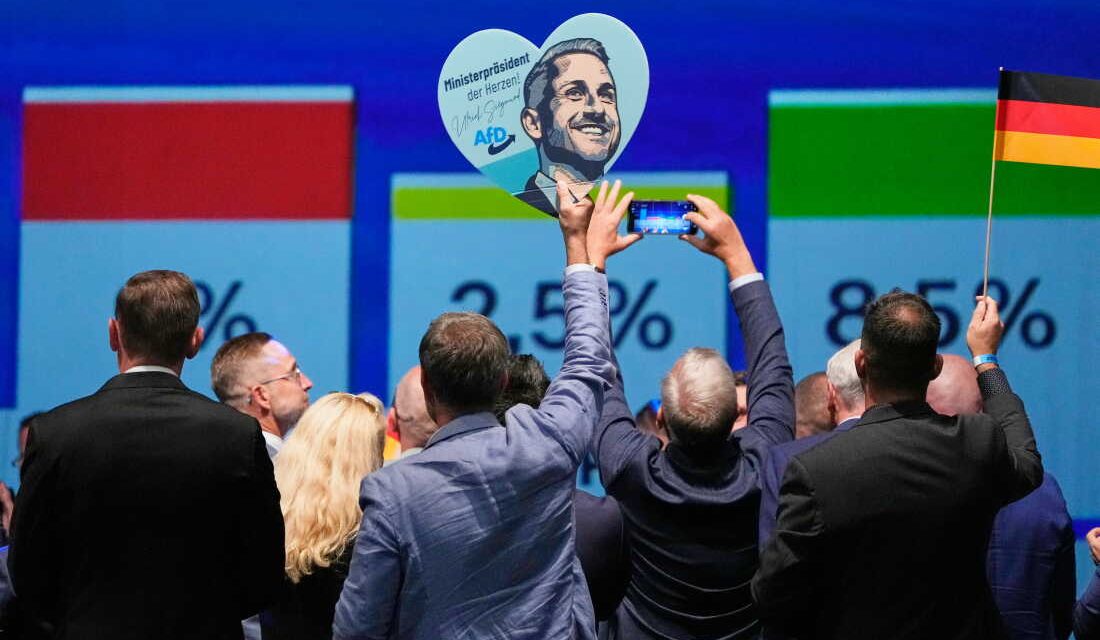
In Magdeburg, Germany, AfD supporters celebrated their top candidate Ulrich Siegmund’s success in the Saxony-Anhalt state election. The Alternative for Germany party, known for its far-right and populist stance, claimed victory by securing 43.8% of the vote, the highest ever for the party in a German state election. This result has led to significant political upheaval. Despite falling short of an absolute majority, discussions are unfolding around potential governance by the AfD.
Reactions to the election results have varied. Ulrich Siegmund, AfD’s candidate for state governor, expressed that this outcome is a clear signal to Germany’s capital, Berlin. He conveyed that the electorate desires a return to a previous state of security and stability in Germany.
While the polls had suggested a strong lead for AfD, the Christian Democratic Union saw its share of the vote more than halved, dropping to 17.2%, marking a historic decline. Other parties, including the Social Democrats at 9.3%, the Greens at 8.9%, and the Left party at 8.6%, have declined any coalition with AfD. A possible coalition with BSW, a small left-wing populist party with an anti-immigration stance, has been speculated, as BSW obtained 5.3% of the vote.
The AfD’s platform, especially in Saxony-Anhalt, is seen as radical by Germany’s domestic intelligence, which has classified it as extremist. The party’s agenda prominently includes a remigration policy aimed at mass deportations. Siegmund expanded on this policy in a public broadcast, stating it targets individuals—such as unemployed Ukrainian refugees—who do not contribute to society. He also emphasized policies for segregating refugees and disabled children in schools while adjusting historical education to a ‘more positive’ perspective.
Upon the announcement of the results, international reactions emerged. Former U.S. President Donald Trump shared the results on social media, supported by Russian envoy Kirill Dmitriev. Tesla CEO Elon Musk also expressed approval, thanking Siegmund. However, contrasting views were voiced by Polish Prime Minister Donald Tusk and France’s Europe minister Benjamin Haddad, highlighting concerns over the implications for Europe.
Christian Democrat candidate Sven Schulze recognized the democratic nature of the result but showed uncertainty regarding potential coalition formations against AfD. Alice Weidel, AfD co-chair, endorsed the party’s growth momentum, attributing part of the success to Siegmund’s dynamic campaign approach.
 Trump Administration Distributes ACA Refund Checks
  Trump Administration’s Approach to Illegal Alien Deportations
  New Jersey Voter Fraud Prompts Renewed Push for SAVE Act
  Concerns Over Changes to Voter-Registration Form for Americans Abroad
  Trump’s 2024 Campaign Targets Young Men Through Cryptocurrency
  Trump’s White House Visitor Center Proposal Gains Bipartisan Support