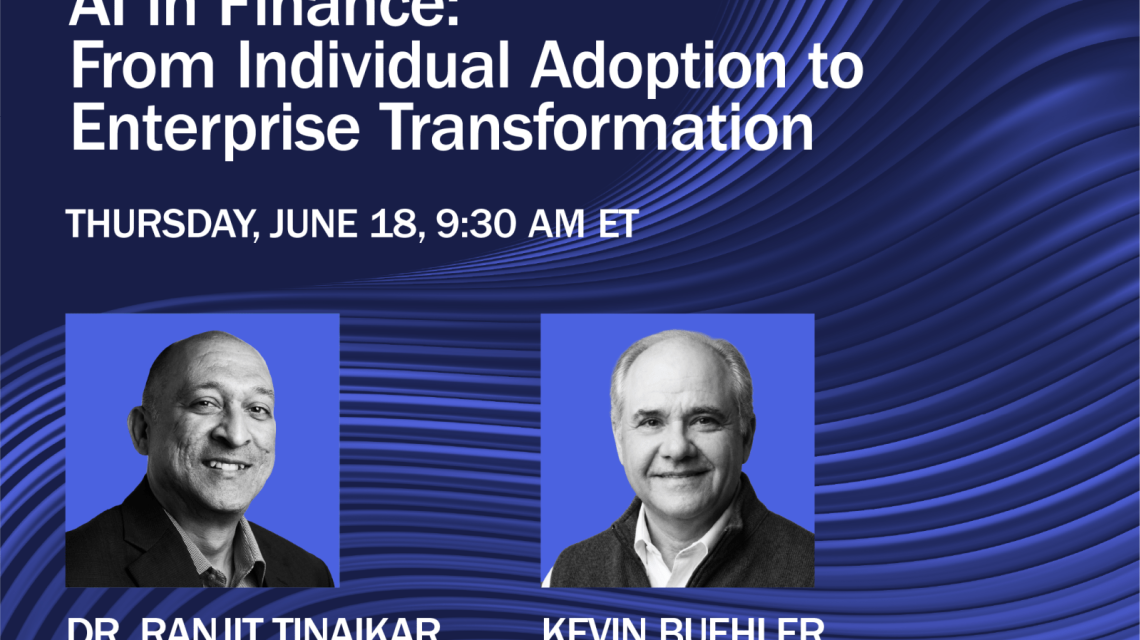
New AI tools are enhancing efficiency for financial professionals, accelerating research, analysis, presentations, and client interactions. Kevin Buehler, chief innovation officer at Rogo and senior partner emeritus at McKinsey & Company, questions how firms will harness this increased speed. Will AI enable them to serve more clients, analyze broader markets, and devote time to complex decisions? Or will productivity gains remain scattered?
These themes will be addressed in Newsweek’s “AI Impact Forum” webinar, “AI in Finance: From Individual Adoption to Enterprise Transformation,” set for Thursday, June 18, at 9:30 a.m. Eastern. Dr. Ranjit Tinaikar will host a discussion with Buehler on how agentic AI could reshape financial services, affecting analysts, investors, software companies, and services firms.
Buehler notes AI’s clear impact on junior professionals, especially in tasks involving PowerPoint, Excel, communications, and analysis. “The power of AI tools and the rise of agentic AI is making a huge difference at the coalface,” Buehler observes. Yet, individual usage is only the beginning.
The next evolution involves integrating AI across entire business processes. Buehler highlights client onboarding, mergers and acquisitions transactions, and lending as workflows that AI might transform. “How do you use AI to take a process like that and really transform it?” he asks. “That’s what I see as the frontier today.”
Job impact discussions will also emerge, with Buehler emphasizing that AI doesn’t simply replace jobs. The focus is on how financial institutions choose to utilize the time and capacity that AI creates. Some may opt for cost savings. Others might enhance coverage, deepen client relations, engage new business, or emphasize training younger employees.
Increased individual efficiency doesn’t automatically translate to enterprise transformation. Firms must integrate AI systematically. Buehler identifies three adoption stages. The first is junior-level usage where analysts improve daily tasks with AI. The second stage involves senior leaders using AI consistently and managing AI-assisted teams. The third stage is a complete end-to-end workflow redesign.
Most institutions haven’t reached the final stage. They need a strategic plan, senior leadership involvement, quality data, talent development, and effective change management. “They probably need data, and that’s often the Achilles’ heel of these programs,” Buehler notes. Upskilling talent is essential since hiring new AI-capable staff alone won’t suffice.
Buehler emphasized the need for strategic transformation in business processes.
The webinar will also link AI adoption within financial firms to its economic implications. Tinaikar and Buehler will explore why human oversight and context remain vital, how specific applications may add value, and how commercial models might change as AI begins handling core tasks instead of merely supporting them.
The competitive advantage may hinge on whether AI becomes an operational necessity rather than just a personal tool. Buehler describes many firms as still in “the very early innings” of this transformative journey.
Register for the free webinar today to explore these insights and more.
 Trump’s 2024 Campaign Targets Young Men Through Cryptocurrency
  How Modern Windows Improve Home Insulation
  State Department Simplifies Passport Process with Online Applications
  Senate Democrats Block Data Center Bill Over Efficiency Concerns
  Future Cities: Ambitious Projects Aiming for Innovation and Sustainability
  High-Profile Hearing and AI Developments: Key Political Moves