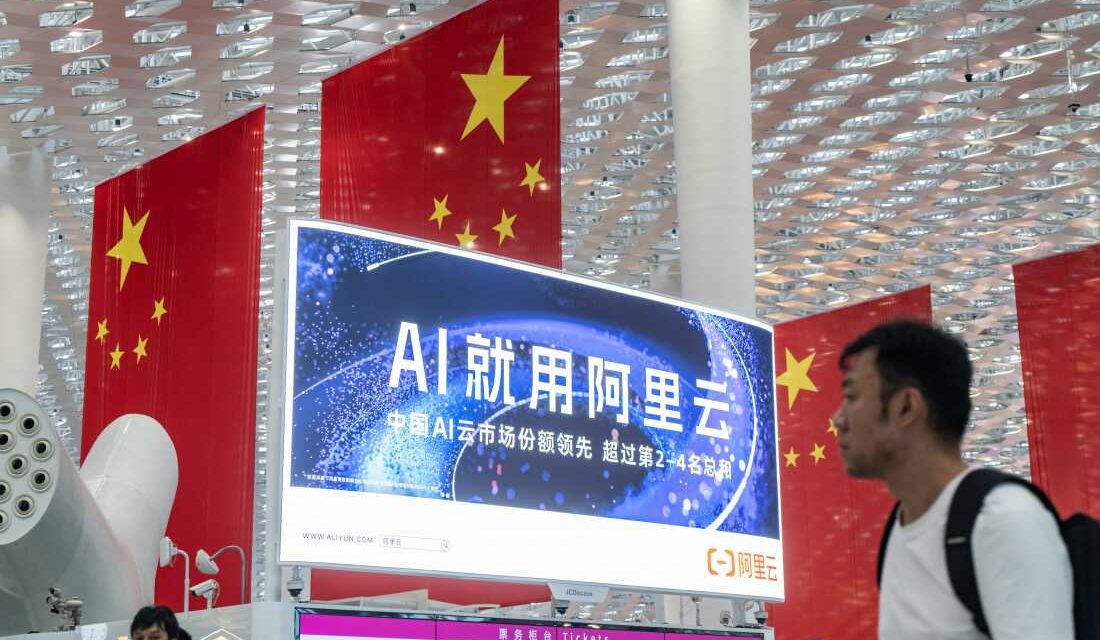
Travelers at Shenzhen Bao’an International Airport in China recently noticed an advertisement for Alibaba Cloud. This reflects the company’s significant progress. Alibaba Group Holding Ltd. reported substantial growth in AI-related products in the latest quarter.
Adoption of AI in China
Elowen Wu, an economics graduate, has experienced AI firsthand. She used chatbots for organizing articles and creating homework outlines. This summer, while interning at an AI startup in Anhui province, she realized the advanced state of AI.
Her exposure to powerful AI tools surprised her. She shared her concerns on Xiaohongshu, asking if she might be replaced by AI. Many in the U.S. share her fear, but China is progressing more rapidly.
Recent legal decisions in China favor workers affected by AI. Courts in several cities have ruled in favor of employees displaced by AI interventions.
Legal Precedents
A court in Guangzhou published the case of a graphics designer, Mr. Wei, who was dismissed after AI took his job. His employer compensated him with 41,000 yuan ($6,000) but cited ‘major changes in objective circumstances’ for his dismissal.
The Guangzhou Intermediate People’s Court validated a lower court’s verdict, ruling the dismissal illegal. The company must pay an additional 35,000 yuan ($5,200). Judge Chen Shiyuan emphasized that companies should provide alternative roles or training before contract termination.
Similar decisions occurred in other cities. Wu believes legal protection is crucial, though implementation might take time. Globally, there is growing interest in these Chinese cases.
Guang Li from Taylor Wessing’s Munich office noted increased interest from Europe regarding China’s approach to AI-driven layoffs.
Challenges and Comparisons
China’s labor laws offer strong protection. Li notes that compared to nations like Germany and the U.S., China’s labor laws might be more protective. However, enforcement remains a challenge.
Eli Friedman, a Cornell University professor, highlights vulnerabilities in China’s labor market. In Hangzhou, a tech worker won a case against an AI-driven job loss earlier this year. Age can be a factor, as workers in their mid-30s face diminishing employment prospects.
With China’s sluggish economy, employers aim for cost savings, with youth unemployment notably high. Wu mentions the stiff job competition, especially for recent college graduates.
The AI Race
The AI competition between China and the U.S. further complicates matters. AI is reshaping the workforce landscape.
Wu continues her education, staying informed about AI advancements through podcasts and videos. By understanding AI’s limitations, she hopes to reduce its intimidating nature.
Jasmine Ling contributed to this report.
 Trump’s 2024 Campaign Targets Young Men Through Cryptocurrency
  How Modern Windows Improve Home Insulation
  State Department Simplifies Passport Process with Online Applications
  Senate Democrats Block Data Center Bill Over Efficiency Concerns
  Future Cities: Ambitious Projects Aiming for Innovation and Sustainability
  High-Profile Hearing and AI Developments: Key Political Moves