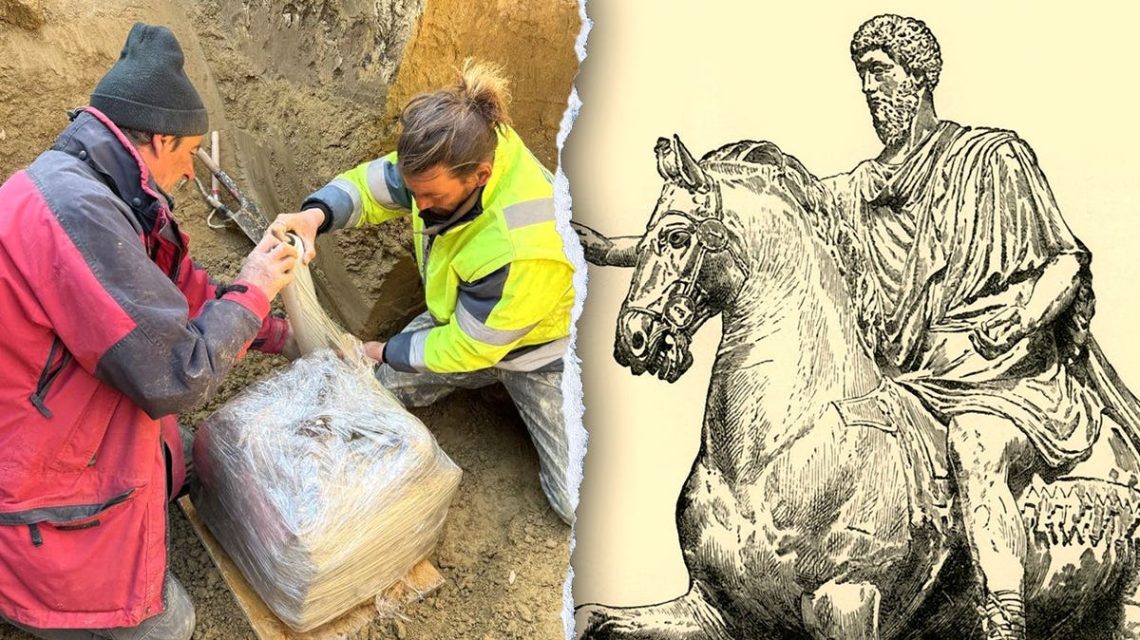
Archaeologists have uncovered an ancient Roman military camp in Slovakia, linked to the reign of a legendary Roman emperor. This significant find includes the remains of soldiers, weapons, and armor.
The site was discovered near Šurany in western Slovakia. The Institute of Archaeology of the Slovak Academy of Sciences (SAS) announced the discovery earlier this summer during an excavation preceding the construction of an industrial park. The excavation covers approximately 370 acres.
This second-century A.D. camp dates back to the reign of Emperor Marcus Aurelius. Aurelius, who ruled from 161 to 180 A.D., is renowned for his role as a formidable leader and Stoic philosopher. His writings, compiled in ‘Meditations,’ remain influential today. The Marcomannic Wars, a series of intense conflicts with Germanic tribes, are thought to have taken place during this period.
The Šurany camp is unique as it deviates from the typical Roman camp layout. Instead of the standard rectangular design, this site features an irregular layout while preserving key Roman camp elements. Archaeologists identified five entrance gates, fortifications, and a clavicula, a distinctive gate with a curved ditch and rampart. Notably, this is the first clavicula gate discovered in Slovakia.
In addition to the structural layout, archaeologists found a significant number of human skeletal remains. These remains, along with weapons and armor, were discovered in storage pits, wells, and shallow graves. These findings suggest numerous Roman soldiers once occupied the site. Lead archaeologist Marek Vojteček notes that the evidence fills a crucial gap in understanding Roman activities north of the Danube in the second century.
Among the artifacts recovered are Roman military equipment, including spears, helmets, armor fragments, and the distinctive caligae sandals identified by their iron hobnails. Everyday items such as axes, knives, and gaming dice were also found.
The research at this site is ongoing and expected to continue for years. Matej Ruttkay, director of the Institute of Archaeology, stated that the discovery holds significant importance beyond Slovakia’s borders. The findings shed light on Roman military operations following a conflict with Germanic tribes.
This discovery is one among many recent Roman finds in Central Europe. Last year, a mass grave was unearthed in Vienna, and in Switzerland, an ancient Roman building’s remains were found. These discoveries continue to contribute to the understanding of Roman history in the region.
 Climate-Resistant Rock Glaciers: Hidden Water Resources
  California Voters to Decide on $7.5 Billion State Research Fund
 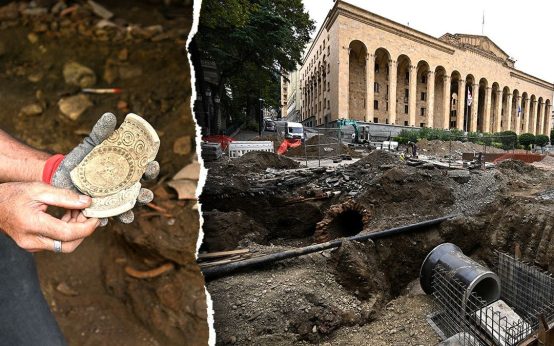 Ancient Pottery Unearthed During Roadworks in Tbilisi
  U.S. Space Academy Announcement
  The Need for New Strategies in Oregon’s Wildfire Management
 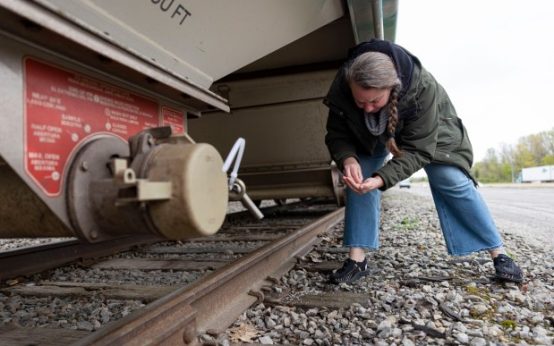 Plastic Pollution in the Great Lakes: A Growing Concern