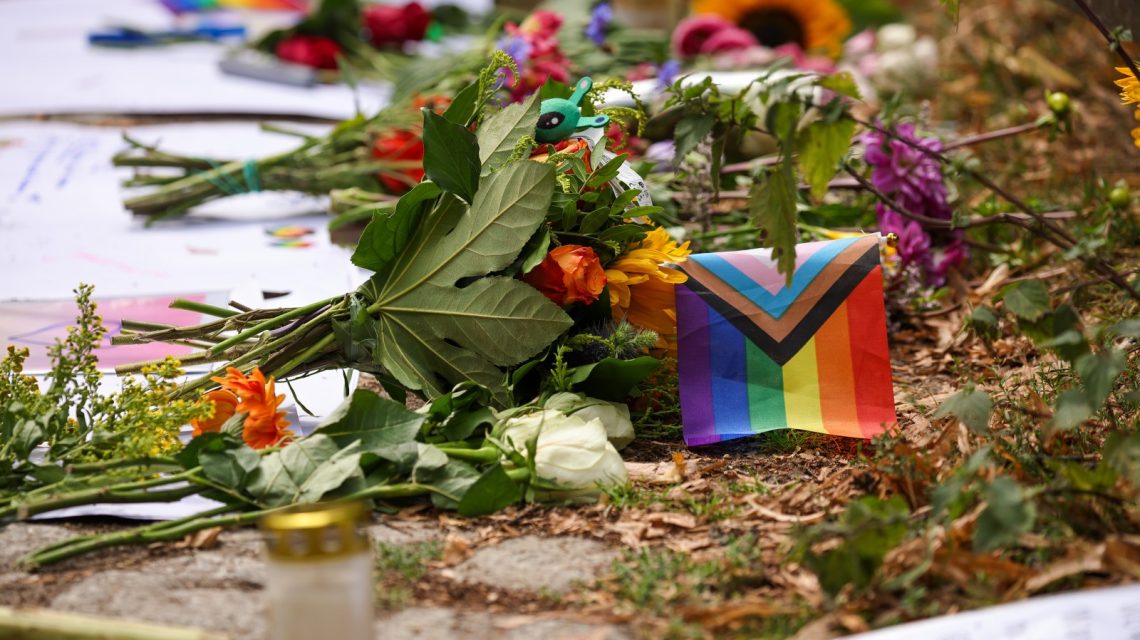
The rainbow flags hung peacefully over Berlin during Christopher Street Day, one of Europe’s major Pride events, until chaos ensued. Near Tiergarten, a rented van plowed into the crowd. Police reported that the driver emerged wielding a bladed weapon, further attacking bystanders. The violent incident resulted in the death of a woman and injuries to 29 others. Authorities shot the suspect, 21-year-old Abdul Ballout, a German national of Lebanese heritage, after he aimed the weapon at officers.
Germany’s interior minister, Alexander Dobrindt, labeled the event an Islamist attack. The incident underscored flaws in security, revealed human tragedy, and provided political leverage to Germany’s far-right faction. Moreover, it disrupted a tenuous coalition within progressive politics: Pride activism’s connection to pro-Palestinian solidarity. Historically, rainbow, transgender, and Palestinian flags have coexisted at numerous marches across the US and Europe.
The attack sharply challenges the notion of ‘Pride for Palestine.’ Success depends on separating Palestinian civilians from Hamas while acknowledging the Islamist tradition cited by recognized terrorist organizations as oppositional to the freedoms championed by Pride movements.
The combination of a Pride event attack and German claims of Islamist terrorism transforms an abstract debate into a practical quandary. How does a movement centered on individual freedoms reconcile treating Palestinian ‘resistance’ as a straightforward ally while ignoring the authoritarian ideas propagated by Hamas and similar groups?
M. Zuhdi Jasser, co-director of the CLARITy Coalition and founder of the American Islamic Forum for Democracy, highlighted the core ideological issue: “This is not a right-versus-left story. The CLARITy coalition has maintained for years that the conflict arises between universal and individual rights and Islamism. Islamists are Muslim theocrats, who oppress women, oppose free speech, and advocate for executions of apostates.”
Western progressives face a challenge—defending Palestinians while honestly addressing Hamas. In Pride spaces, the language of liberation sometimes veers towards romanticizing armed movements. Jasser pointed out that treating Hamas chiefly as an oppressed people’s armed expression turns a blind eye to its religious authoritarianism.
“Hamas is not simply a Palestinian liberation movement with regressive gay views. Anti-gay violence is rooted in the international Islamist ideology from Hamas, the IRGC, to ISIS and Wahhabi movements globally, contributing to radicalization,” Jasser stated.
This complicates the idea of combining Pride and Hamas-aligned ‘resistance’ politics without contradiction. However, queer Palestinian activists argue that Israel and supporters eschew LGBTQ rights to distract from their treatment of Palestinians. This concept of ‘pinkwashing’ faults Israeli claims of gay rights as overlooking issues such as occupation and displacement.
Groups like ACT UP New York have historically integrated Palestinian support into Pride actions. They argue that Pride is a protest against state and police authority, and should align with groups facing similar adversities. The U.S. Campaign for Palestinian Rights views ‘Palestine as a Queer Struggle,’ highlighting overlapping oppressions faced by queer Palestinians due to militarism and discrimination.
Nevertheless, it’s crucial to state that Hamas, ISIS, and the Iranian regime oppose gay rights and freedoms. Acknowledging this is not anti-Palestinian or anti-Muslim; it is essential honesty after an alleged Islamist attack at a Pride event.
Jasser emphasized, “Solidarity with people differs from supporting the armed factions oppressing them. Confusing the two misguides well-meaning individuals into supporting those who may victimize them.”
The issue with ‘Pride for Palestine’ isn’t the concern for Palestinians; it lies in avoiding clarity about which Palestinian groups are supported, excused, or condemned.
Far-right group Alternative for Germany (AfD) finds itself entrenched in this narrative. The Berlin attack magnifies an existing contradiction within ‘Pride for Palestine,’ which AfD is poised to exploit. AfD contends that mainstream parties hesitate to candidly discuss Islam, immigration, and public safety. A suspected Islamist attack on a Pride event provides the party with a compelling argument.
The AfD positions Islam as a cultural threat while recognizing individual Muslims who accept Germany’s constitutional framework. It advocates for stringent measures against Islamism and migration but also rejects gender politics, promoting a traditional family model. The party aims to engage gay voters by emphasizing protection against Islamist violence despite its opposition to contemporary LGBTQ agendas.
Alice Weidel, AfD’s leader who is openly lesbian, complicates the party’s stance, allowing AfD to claim it’s not anti-gay, despite criticisms of its platform. The Berlin incident fortifies AfD’s narrative that Islamist anti-gay violence is real, and some progressive factions are reluctant to acknowledge this.
For voters fearful of Islamist violence, AfD’s approach might suffice if mainstream parties cannot distinguish between Islamism criticism and anti-Muslim prejudice. This situation resonates with American readers, as parallel debates arise within U.S. Pride politics. Although the U.S. differs from Germany, American political dynamics are shifting with immigrant influences, and similar coalition concerns are present.
Jasser argues that the focus should be on individual freedom over political affiliations. “Defending individual freedoms and the social contract, where personal rights outweigh tribal loyalties, epitomizes Western ideals,” he noted.
The Berlin attack’s message isn’t about choosing sides between Palestinians and Israelis; it’s about whether liberal democracies can distinguish defending Palestinians from rejecting Hamas, condemning Islamist violence without vilifying Muslims, and protecting LGBTQ rights while recognizing the political diversity of allies. These distinctions, though uncomfortable, are vital, as political extremism capitalizes on their absence.
Jasser warned, “You can’t address a problem if you don’t identify it.” Ignoring these crucial points leaves an opportunity open for extremists. Should liberals avoid discussing Hamas, the right may address it, potentially wielding the truth as a tool for their agenda.
 Support for White Nationalism Among Young White Males in the U.S.
  Exhaustion Among Americans in Trump’s Second Term
  The Inhumanity, Cost, and Bias of the Death Penalty
  Trump’s Promise of $5,000 for Every American Adult
  Australia Investigates FlyDubai Incident Amid Security Concerns
  Trump Encourages Mail Voting Despite Prior Criticisms