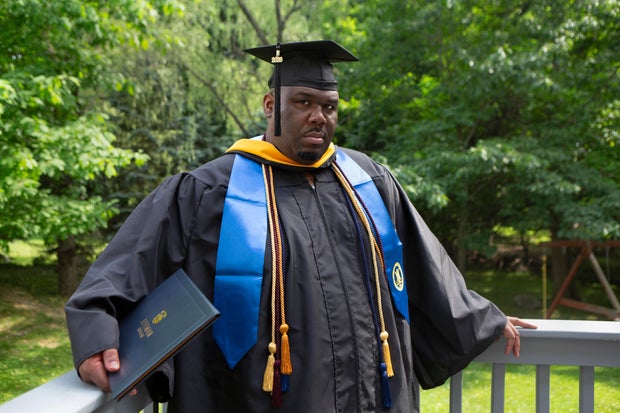
Benjamin Pinckney, a 46-year-old, has dreamed of becoming a physician assistant since surviving a drive-by shooting in Jacksonville, Florida over two decades ago. During his hospitalization, a physician assistant warned him about the dangers Black men face with gunshot wounds, igniting his desire to pursue this career path.
Pinckney worked for New York City’s Department of Sanitation and served as an Army Reserve medic before graduating with honors from Lehman College in 2026. He then intended to apply for physician assistant programs. However, he’s concerned that recent changes to federal student loan rules might hinder his plans. A new law caps the amount graduate students can borrow from the federal government, potentially forcing him to rely on private banks offering higher interest rates.
Starting July 1, federal graduate student loan limits will be imposed as part of the One Big Beautiful Bill Act, a GOP tax-and-spending legislation signed by President Trump. This measure aims to control higher education expenses and student debt. Critics argue that the borrowing limit of $20,500 annually is insufficient, claiming it fails to cover tuition, housing, and living expenses, potentially deterring diverse candidates from fields like healthcare.
The American Academy of Physician Associates, among other groups, has voiced concerns, suggesting the new limits won’t address the root of high education costs. Todd Pickard, the organization’s president, compared the approach to treating a hangnail by amputation instead of appropriate care.
Many students pursuing ‘professional degrees,’ like doctors and pharmacists, face a total borrowing limit of $200,000, with an annual cap of $50,000. Public and private medical school costs far exceed these amounts, leaving students to seek high-interest private loans with limited repayment flexibility.
Olivia Trull, a prospective physician assistant student, highlighted the challenge, estimating a need for up to $100,000 in private loans for her 28-month program costing $137,000. Pinckney’s peers have seen private loan interest rates as high as 13% compared to federal rates of 8-9%.
A federal lawsuit challenges these regulations, arguing the ‘professional degree’ definition is flawed. Another suit insists physician assistant students deserve access to higher loan limits typically available to medical students.
Education Secretary Linda McMahon stressed the intent to decrease education costs, although some experts note instances like the University of California-Irvine reducing MBA tuition due to the law. Yet, a drastic reduction in tuition fees seems unlikely.
The new lending limits may disproportionately impact Black students historically subject to higher borrowing amounts. Andrei Robu, a medical student, worries about potential declines in student body diversity due to the changes.
Jasmine Vasquez deferred her enrollment partly over financing concerns, and Betsy Mayotte of the Institute for Student Loan Advisors foresees enrollment drops and graduate program closures due to these restrictive borrowing limits.
Pinckney is uncertain about his future but remains committed to his dream. Although he considers a biomedical sciences program as a fallback, the new loan limits cast doubt on his ability to work in direct patient care, a long-held ambition inspired by the physician assistant who once changed his life’s trajectory.
 Troy Swanson: Award-Winning Librarian Transforming Academic Libraries
  Cornell University to Investigate Handling of Alleged Assault Case
  Legal Challenge Against School Funding Inequalities in West Virginia
  Increased Funding Needed for Psychiatric Hospitals
  Potential Changes Loom for School Voucher Programs
  Regents Exam Elimination Raises Concerns Over Student and School Accountability