In 1909, architect Daniel Burnham’s vision for Chicago, known as the ‘Plan of Chicago,’ significantly influenced the city’s development, including its parks and open lakefronts. Now, World Business Chicago aspires to identify the next transformative idea through the ‘Horizon Lines’ open design contest. This spring, around 200 creative visionaries submitted their bold ideas for Chicago’s future in 2050, ranging from building islands in Lake Michigan to crafting unique public restrooms throughout the city. On Wednesday, six concepts were unveiled as finalists competing for a $5,000 reward and the possibility of real-world implementation.
Phil Clement, CEO of World Business Chicago, stated in a press release that the finalists met the challenge of imagining a future that blends vision and real opportunity. The contest’s jury, consisting of ten members, selected these finalists. Their work will be displayed at the Chicago Cultural Center throughout the summer, inviting public engagement and feedback. Below are the six innovative concepts vying to reshape Chicago’s skyline:
Green City Rising: Chicago’s Living Network of Neighborhood Arboreta
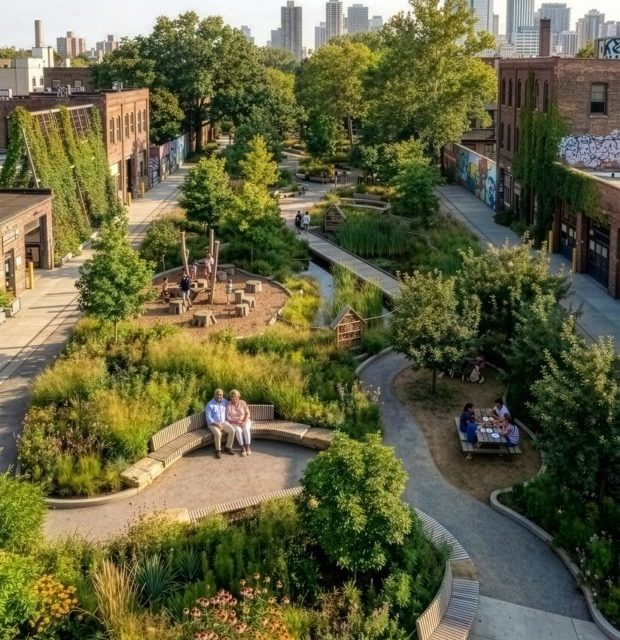
The Morton Arboretum suggests reconnecting to Chicago’s roots with a network of neighborhood mini-forests, embracing the city’s official motto since 1837, ‘Urbs in Horto’ or ‘City in a Garden.’ This plan focuses on increasing tree coverage. Elle Rampel, Chief of Staff at World Business Chicago, noted that the city’s current landscape consists largely of concrete, and this initiative would help restore the greenery that was once prominent.
The Third Frontage Initiative
Submitted by Chicago architecture firms Gensler and Adrian Smith + Gordon Gill, the Third Frontage Initiative aims to revolutionize the city’s 1,900-mile alley network. Transforming these spaces into vibrant areas filled with housing and green infrastructure, the concept envisions a lively new neighborhood streetscape. Tian Ouyang and Yibin Yang, authors of this plan, proposed converting unused garages into homes and adding vegetation to promote community life.
Repairing the Scars of the Interstate Highway Era
The Metropolitan Planning Council proposes turning portions of the Dan Ryan and Eisenhower expressways into tunnels covered by green space, transforming them into pedestrian-accessible parkways. Similar to Boston’s Big Dig project, this idea aims to reconnect neighborhoods divided by highways and create spaces that could be utilized for development and recreation.
Wonderways: Reimagining Chicago’s Boulevards as a Network of Climate Commons
Chicago’s design firm MKSK proposes utilizing the city’s historic boulevard system to create a network of ecological and social landscapes. By expanding tree cover and introducing prairies and micro-forests, the plan aims to reconnect parks and incorporate biodiversity into community spaces. Rampel commented that this effort capitalizes on existing green spaces while promoting more nature and wildlife.
AgriFlats
Wheeler Kearns Architects propose converting Chicago’s food deserts into urban agricultural zones, allowing growers to live and work in interconnected greenhouses. The AgriFlats project would create a food district with greenhouses and attached living accommodations, supporting local restaurants with farm-to-table produce. It aims to generate 230 jobs and transform the Pullman neighborhood with sustainable agriculture.
Re-Loop, The Living Mile
The Re-Loop Vision Coalition envisions a new ‘experience district’ on Chicago’s South Side, featuring sculptures made from recycled materials and space for local artisans. This project seeks to repurpose undeveloped land near Rate Field into a creative and sustainable tourist attraction. The concept leverages local salvage businesses and aims to revitalize the area’s tourism appeal.
World Business Chicago will announce the winner on September 15, with the public exhibition running until September 20. Visitors can view additional submissions at the Cultural Center, including unique ideas like elevated fountains and artistic public restrooms, all inspired by Chicago’s tradition of ambitious design.
 How Modern Windows Improve Home Insulation
  OpenAI’s Delay of GPT-6.1 Astra Driven by Security Concerns
  Bill Gates Warns Against Potential Risks of AI Technology
  Recent Technology Trends Shaping 2026
  Enterprise Transformation with Generative AI
  Data Centers and Community Divisions: The Growing Debate Across America