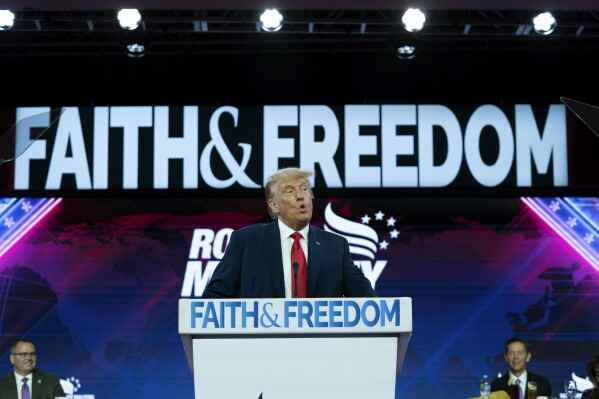
The U.S. Constitution makes no mention of Christianity or any specific faith, while the Declaration of Independence cites a “Creator” and “Nature’s God” without detail. Yet, many Americans, especially Republicans and white evangelicals, see the U.S. as a Christian nation. This view is visible in the supporters of Donald Trump’s presidential ambitions.
Perspectives on a Christian America vary. Some Americans hold broad God-and-country sentiments. A smaller, more intense group believes the U.S. Constitution was God-inspired and that the government should officially make the nation Christian by emphasizing Christian values, or eroding the church-state separation. Those with these beliefs are often skeptical of immigrants, downplay racial discrimination, and support Trump, according to a 2021 Pew Research survey. This movement is known as Christian nationalism, fusing American and Christian values.
Eric McDaniel from the University of Texas notes that Christian nationalism offers an origin story, suggesting America is here for divine work. This belief often avoids darker historical events and connects with ideas from Manifest Destiny to Trump’s slogans. Trump has suggested religious criteria for immigration, echoing Christian nationalist ideals, a position echoed by many conservatives and Republicans.
Republican House Speaker Mike Johnson claims America began as a Christian nation, citing Thomas Jefferson’s divine inspiration in drafting the Declaration of Independence. Johnson links to WallBuilders, a group asserting Christian roots through criticized historical claims, currently challenging ad restrictions in Washington for promoting founding beliefs.
Supporters like Steve Bannon and Charlie Kirk frame current politics as a spiritual battle, viewing the U.S. as founded by Bible-believing Christians. Recent Republican platforms in states like Texas, Oklahoma, and Kentucky reflect similar sentiments. Rev. Robert Jeffress believes America was founded on Christian principles but does not identify as a nationalist.
Anthea Butler from the University of Pennsylvania argues that the Christian nation idea is historically inaccurate and exclusive, centering on Anglo-Saxon Protestants while dismissing others as “heathens.” This has justified the domination of enslaved blacks and Native Americans.
John Fea, a historian and author, states that claims of a Christian founding are politically motivated and historically weak. Although six in ten adults might agree with the idea of Christian roots, deeper surveys suggest only a minority strongly adhere to this belief.
The Constitution ensures religious freedom without preference for a single faith. Historically, some early states funded churches, but all ceased this practice eventually. Key founders, such as Jefferson and Franklin, admired Jesus but did not view him as divine.
Fea highlights the importance of nuance in historical debates about religion and government, criticizing both religious and secular extremes. His work emphasizes understanding the complexity of 18th-century perspectives.
This content is supported by The Conversation US and funded by the Lilly Endowment Inc., with AP retaining sole responsibility.
 Trump Announces $100 Checks for Seniors to Aid Medicare Part B Premiums
  Trump Suggests His Name for Major Alabama Bridge Project
  California’s Challenges: Solutions Needed at State Level
  Protests Against Proposed Trump Arch in Washington D.C.
  Republicans Boost Spending in Ohio Senate Race Amid Growing Concerns
  Kushner Criticizes CNN Article Over Claims of Conflict of Interest