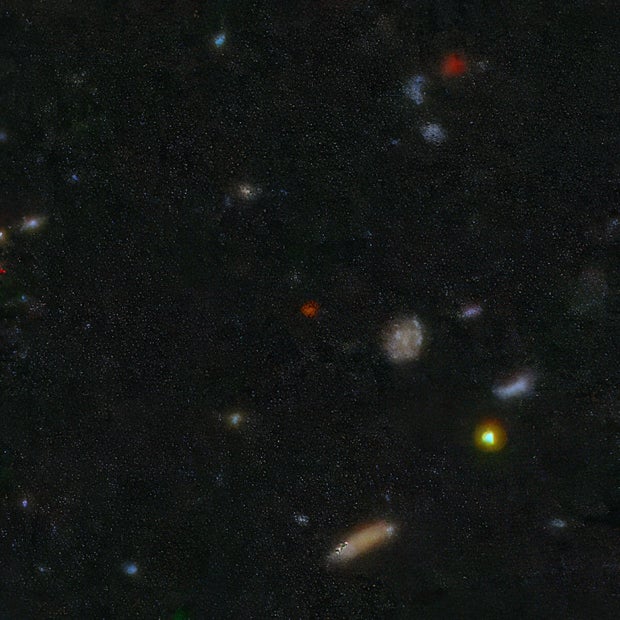
On November 24, 2026, scientists made a groundbreaking discovery at Cape Canaveral, Florida. A team led by German researchers identified the most distant quasar known to date. This celestial body, originating from the early universe, contains a black hole at its core and formed within 630 million years of the Big Bang. The cosmos is approximately 13.8 billion years old, making this discovery significant.
The European Space Agency’s Euclid telescope captured this quasar, setting a new record by revealing details dating back nearly 40 million years earlier than previously known quasars. The Euclid telescope, launched in 2023, focuses on studying galaxies to understand dark matter and dark energy that influence the universe’s expansion.
Julien Wolf from the European Southern Observatory highlighted the rarity of finding such an early quasar. Its massive black hole is notable for its slow consumption rate of surrounding material. The telescope captured it as it appeared 13.1 billion years ago, representing less than 5% of the universe’s current age. Wolf named this quasar Dun Aonghasa, inspired by the ancient stone fort in Ireland’s Aran Islands, reflecting the promise of new horizons.
The study’s credibility is supported by observations from the Hubble and Webb space telescopes, along with other ground-based and space-based observatories. The Webb telescope revealed that the quasar’s black hole has a mass equivalent to 360 million solar masses, an extraordinary size for its early cosmic age. These findings are published in the journal Astronomy & Astrophysics.
Dun Aonghasa offers a new perspective on the early universe. Within 630 million years of the Big Bang, its black hole had unexpectedly grown to a massive size. Julien Wolf expressed ongoing excitement, noting that these kinds of records might soon be surpassed or endure for years.
 Exploring the World of Solitary Bees in Urban Environments
 Pacifica Pier Collapses Amid King Tides, Intensifying Coastal Hazards
 Jensen Huang Returns to Nvidia and AI’s Breakthrough in Mathematics
 Understanding the Impact of the Strongest El Niño in Years
 Community Opposition and University Plans Clash in Ypsilanti Township
 Rare Burbot Fish Found in New York with Unique Color