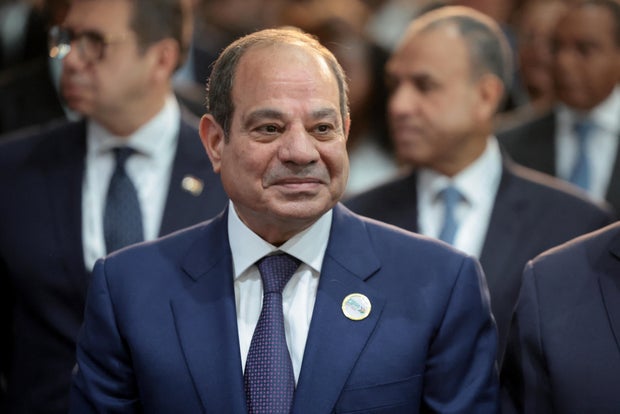
Egyptian President Abdel Fattah al-Sisi has sought authorization from the country’s Parliament to deploy military forces in support of Saudi Arabia. This request follows escalated attacks by Yemen’s Iran-backed Houthi rebels, which have targeted Saudi Arabia’s airports and oil facilities.
Al-Sisi emphasized that Egypt’s involvement would be defensive and contingent upon a formal request from Saudi Arabia. He stated, “Egypt will take any measures requested by Saudi Arabia to protect and defend it,” during a military graduation ceremony.
Per Egypt’s Constitution, the president must consult the National Defense Council and obtain a two-thirds parliamentary approval before deploying armed forces abroad. On Sunday, al-Sisi convened a meeting of the National Defense Council to discuss the increasing regional tensions and “unacceptable attacks” on Saudi Arabia.
“All necessary and possible forms of support will be provided to the sisterly Kingdom of Saudi Arabia to defend its security and stability,” vowed the council.
Egypt has previously avoided engaging in recent regional military conflicts, preferring political solutions. Some consider this approach one of al-Sisi’s significant achievements.
Samir Ragheb, a retired army brigadier and political analyst, remarked on Egypt’s commitments to regional security. He told CBS News, “Egypt has repeatedly pledged to support the Gulf states’ security. In times of war, such promises must be fulfilled; otherwise, they are merely empty threats.” He noted the Gulf states’ financial investments in Egypt and commented that Egypt should reciprocate.
Parliament held an emergency session on Sunday. While the vote on the resolution was anticipated for Tuesday, it was postponed to next Monday. The Egyptian Social Democratic Party instructed its bloc to abstain from voting, citing a lack of information on the mission’s scope, costs, and risks.
Ragheb expressed concerns over further escalations in the region, pointing out threats beyond the Houthis, including Iran, Iraqi militias, and internal sleeper cells. He argued that Egypt risks losing regional influence if it doesn’t intervene. “To be a regional player, you must play a role,” he asserted.
Ragheb suggested the U.S.’s reluctance to confront the Houthis has left a vacuum that Egypt should fill as part of the Arab bloc. Other regional powers are actively pursuing similar roles. In August, Saudi Arabia signed the Mecca Accords with Turkey and Pakistan, indicating a shift from reliance on U.S. defense.
 Efforts to Release American Teacher Held by Russia
 Efforts to Release American Detained by Russia and Recent Political Developments
 Escalating Houthi Attacks Prompt U.S. Security Alerts in the Middle East
 Arrests Linked to Alleged Iranian Plot Against U.S. Bomber Base
 Trump’s Bold Endorsement of Netanyahu’s Political Future
 France Imposes Curfews Amid Widespread Riots