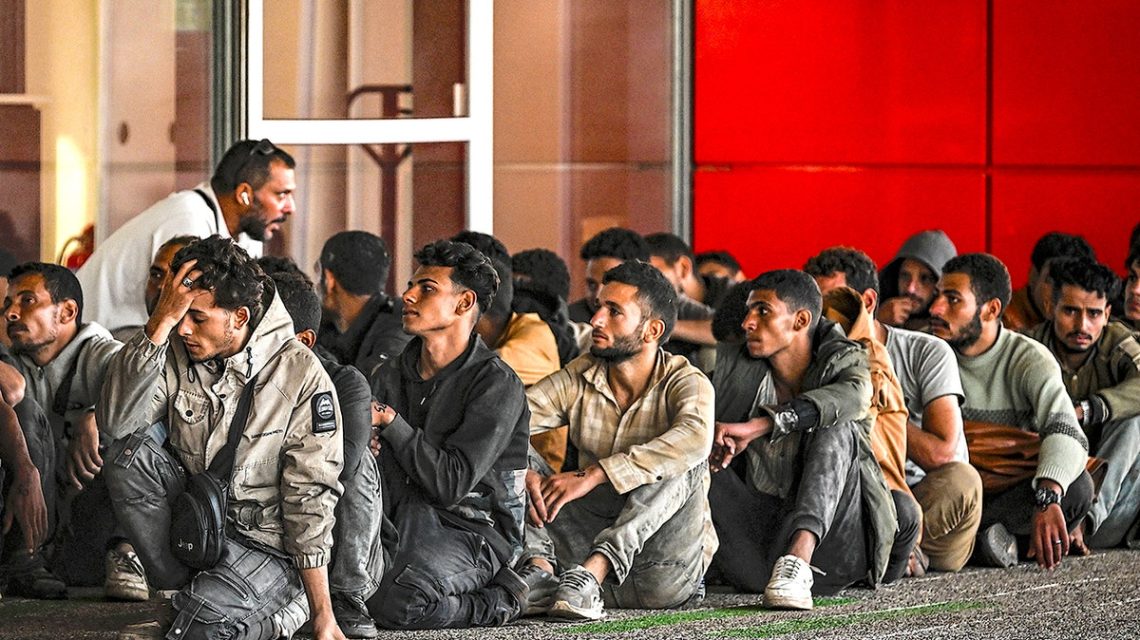
In June, the European Union enacted new border policies in response to concerns about illegal immigration, highlighted by President Donald Trump and many European citizens. These updated laws prioritize the processing and deportation of undocumented migrants entering the 27-nation bloc.
The EU’s new framework mandates that asylum seekers undergo screenings for identity, security, and health before accessing the asylum system. Border officials are now required to track non-EU citizens entering and departing, utilizing biometric data such as fingerprints and facial recognition. Moreover, member states must collaborate and share information.
According to the Associated Press, this provisional agreement among the EU’s main institutions awaits approval from EU lawmakers and national governments.
Alan Mendoza of the Henry Jackson Society expressed concerns about cultural integration, stating that Europe’s demographic shift challenges local customs. Although the U.K. is no longer an EU member, Mendoza notable Britain’s influence on the new rules. He noted Britain’s challenges in establishing offshore holding centers, arguing this would deter migrants seeking refuge in the U.K.
Experts caution that delays in addressing illegal immigration exacerbate the issue. Some argue the situation may already be difficult to manage. Ordinary citizens have seen these challenges for years, but leaders are now beginning to respond.
President Donald Trump criticized Europe’s handling of migration during a United Nations General Assembly address. He warned of the damages caused by large numbers of undocumented migrants, claiming Europe faced an unprecedented influx.
Last week, Vice President JD Vance reflected on the tragic murder of an 18-year-old British man. Vance commented on the failure of European authorities to protect citizens and criticized the influence of self-critical policies leading to societal decay.
U.S. Secretary of War Pete Hegseth addressed the ongoing issue at a D-Day commemoration in France. He questioned European capitals’ responses to immigration, urging a strong stance against what he described as an ideological invasion.
In a divergence from the EU’s overall approach, Spain chose to legalize half a million undocumented migrants, providing them with papers and social security. Javier Negre of La Derecha Diario attributed this shift to non-governmental organizational pressures. Despite criticism, mainly from left-leaning groups and NGOs, supporters see this policy as compassionate.
The French Green party’s Mélissa Camara described the EU’s decision as a setback for human rights, criticizing aspects that seemingly promote xenophobic ideologies. The Associated Press provided contributions to this report.
 Mayor Mamdani Responds to Netanyahu’s United Nations Speech
  British Prosecutors Charge Man with Terrorism Over Politician’s Murder
  Backlash Against Trump’s White House Photos
  State Department Accuses Senate Democrats of ‘Grandstanding’ Over Venezuela Oil Deal
  EU Plans Deportation of Rejected Asylum Seekers
  British Police Arrest Man Suspected of Terror Plot