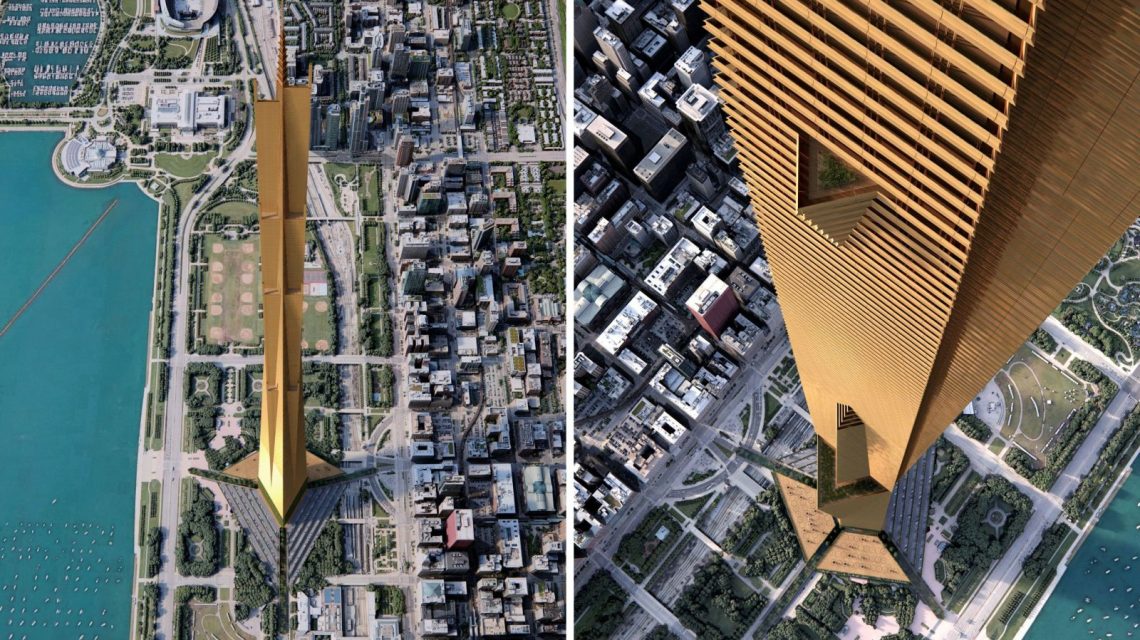
Nearly 70 years ago, Frank Lloyd Wright revealed plans for an extraordinary skyscraper called The Illinois. This mile-high structure would have surpassed every existing building on Earth. Spanish architect David Romero has now revived this visionary design through detailed 3D renderings, reviving Wright’s ambitious concept for modern audiences.
The Illinois was envisioned as a 528-story “city in the sky” that aimed to transform urban living and redefine architectural boundaries. Romero’s photorealistic reconstructions offer a visual representation of what this futuristic megastructure might have looked like in the Chicago skyline. Romero’s work on The Illinois appears in an issue of the Frank Lloyd Wright Quarterly magazine, renewing interest in Wright’s unbuilt designs.
“I’d wanted to tackle the Illinois for a long time; it’s Wright’s most famous unbuilt design,” Romero mentioned in an interview.
Debate in Modern Architecture
The resurgence of interest in Wright’s design comes amidst debates about architecture’s future direction. Architect Gordon Gill, responsible for the Jeddah Tower, currently under construction in Saudi Arabia, suggests that the future lies in revitalizing existing buildings rather than constructing taller ones. The American Institute of Architects supports this view, asserting that reusing existing structures can reduce carbon emissions significantly compared to building new constructions.
Reviving an Iconic Design
Romero, known for his project Hooked on the Past, focused on recreating unrealized architectural designs. He postponed The Illinois project until he had thoroughly studied and modeled Wright’s completed towers. This included the S.C. Johnson Research Tower and Price Tower, which provided vital references to address the gaps in Wright’s original drawings.
Creating these detailed renderings was a substantial task. “It took several months of my spare-time work,” Romero noted. The model was extensive because he wanted to realistically place the tower within the existing Chicago skyline, ensuring that the structure was not depicted in isolation.
Features of Wright’s Tower
During the creation process, Romero gained a deeper understanding of the building’s internal logic. He was surprised by how its scale fit within real-world dimensions. Although the tower’s height appeared provocative on paper, Romero discovered through modeling that it stood on strong architectural principles. Wright’s design was not simply about achieving height but was a structural response to wind forces at great heights.
“This wasn’t fantasy engineering,” Romero explained. Wright’s design principles had been tested in completed buildings.
Feasibility in Modern Times
Romero believes parts of Wright’s design still apply today despite its roots in 1950s technological optimism. Wright’s foundation concept and the design to withstand wind forces resemble modern engineering methods for supertall structures. However, certain elements like Wright’s proposed atomic-powered elevators and building systems do not meet today’s standards.
“The Illinois works best as a conceptual proof,” Romero describes the design, illustrating how Wright’s ideas pushed structural boundaries rather than serving as a practical blueprint.
A Visionary Vertical City
Wright’s skyscraper concept remains relevant for future urban planning. The Illinois was designed as a comprehensive vertical city combining housing, offices, commerce, and transportation. This forecasted today’s mixed-use vertical developments promoting urban density over suburban expansion.
According to Romero, The Illinois would have fundamentally changed the Chicago skyline. At a staggering height of one mile, it wouldn’t have shared the skyline with other buildings. This transformation remains a point of intrigue for architects exploring height, density, and urban futures.