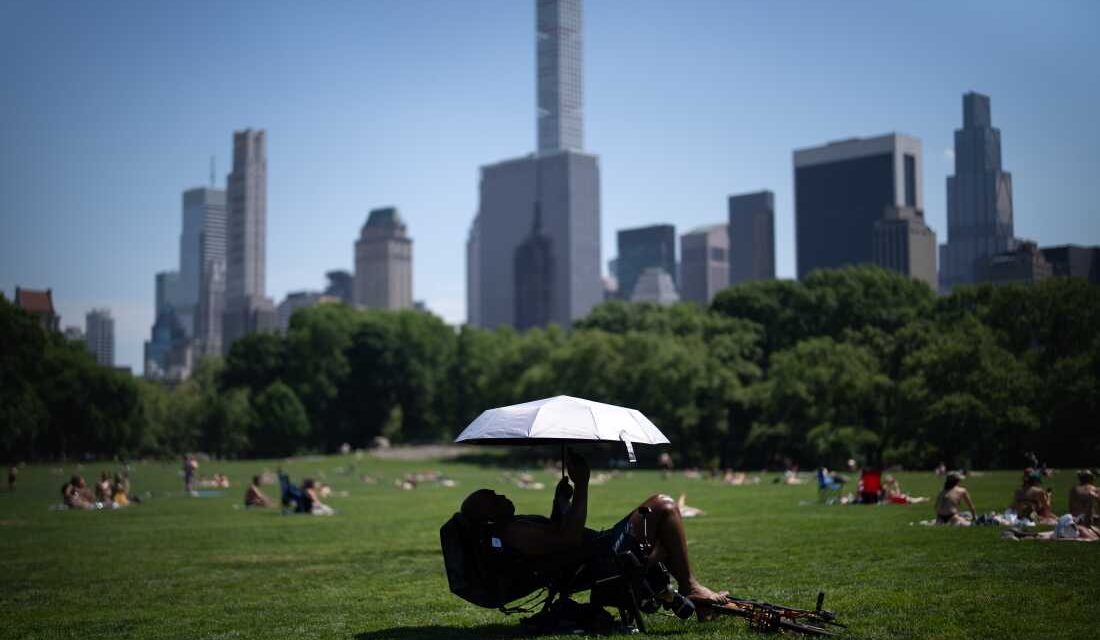
During a heat advisory in Central Park, New York City, a person shields themselves from the sun using an umbrella. As extreme heat envelops most of American states through the July 4 weekend, forecasters caution about the potential dangers.
The National Weather Service (NWS) highlighted that “dangerous to record-setting heat will expand across the eastern two-thirds” of the United States. States including Ohio, parts of North Carolina, and Washington, D.C. will face extreme temperatures and humidity, posing significant risks to individuals with respiratory conditions and the elderly. The NWS warned that “With the combination of high humidity, heat indices may reach 100-110 Degrees. Much of the central and eastern U.S. is under a Moderate to Major HeatRisk, which can pose health impacts on those without hydration or cooling.” Extreme heat warnings are active in regions such as Iowa, Missouri, and Kansas.
A heat dome, a phenomenon where a hot air mass remains stationary over a region, drives the heatwave by getting trapped under a “lid” above the Earth’s surface. High temperatures combined with humidity are the primary concern, stated NWS forecaster Bryan Putnam. “You get temperatures in the 90s to low 100s; that’s obviously pretty hot. But you combine that with the humidity, those heat indices will go well into the 100s, and that’s the temperature that it’s going to feel like,” Putnam explained during an interview with NPR.
The extreme heat condition is expected to persist beyond July 4, extending to the West. Daytime temperatures may feel like 100 to 105 degrees, with the heat limiting relief even overnight. Putnam emphasized that people gathering outdoors for the July 4 celebrations, including evening events like fireworks, need to be cautious. “Your temperatures might stay in the 80s and 90s in the heat in the evening. With the humidity, that’s going to keep those heat indices high as well. Just because the sun goes down doesn’t mean it still isn’t going to be hot,” he noted.
Prepare and Limit Outdoor Exposure
Authorities urge precautions for those in the heat’s path to avoid heat-related health issues. On Sunday, the Missouri State Emergency Management Agency advised everyone to “plan accordingly and limit prolonged outdoor exposure if possible.” They stressed the need for immediate action if someone shows signs of heat-related illness.
The Centers for Disease Control and Prevention (CDC) identifies heat exhaustion, heat rash, and heat stroke as types of heat-related illnesses. Symptoms can include nausea, headache, confusion, and dizziness. New York City Health Commissioner Alister Martin noted heat strokes are “fast, deadly, and almost always preventable.” With his experience as an ER doctor, Martin stated, “I watched heat stroke come through the doors on days exactly like the ones ahead,” in a social media post.
The CDC warns that heat stroke can lead to fatal or permanent disability without emergency treatment. Indicators of heat stroke include confusion, altered mental state, slurred speech, and loss of consciousness. Martin advised everyone to use air conditioning, stay hydrated, and check on neighbors during the heatwave.
 Cargo Plane Crash at Miami International Airport
  Marine Veteran Suing Oregon School District Over Curriculum Reimbursement
  Tennessee Execution Halted as Issues Persist with Lethal Injection Protocol
  Judge Dismisses Case Against Former Olympian Over Lincoln Memorial Incident
  Minnesota Family Files Civil Rights Lawsuit Over ICE Agent Shooting
  California Bans Child Marriage, Protecting Minors