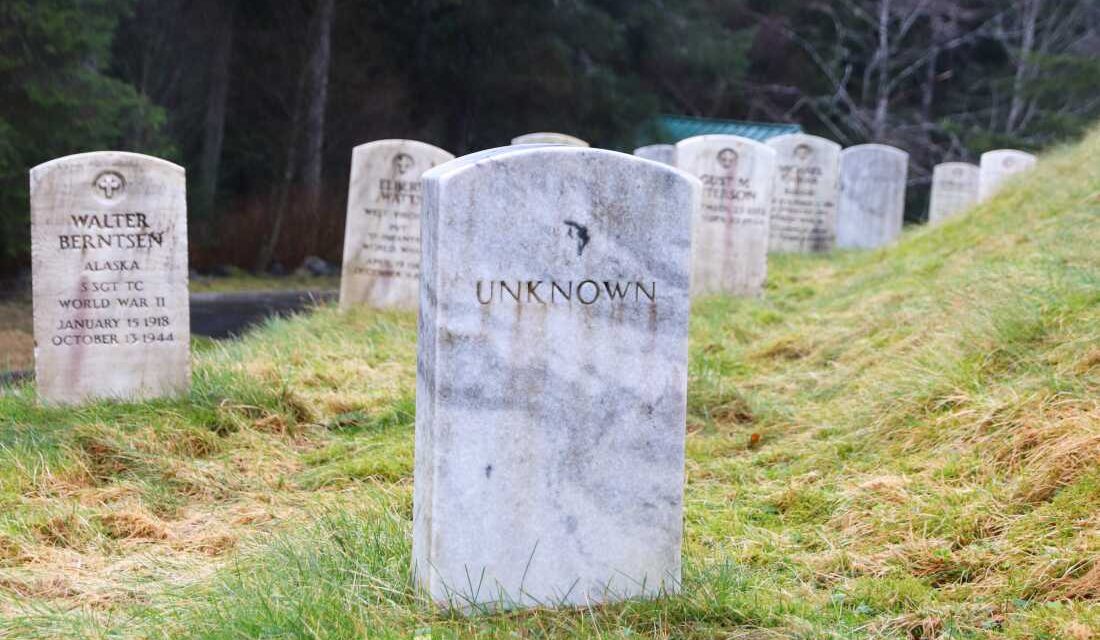
Unraveling the Mystery of X-3
The Sitka National Cemetery in Sitka, Alaska is home to a marked headstone for an unknown soldier referred to as “X-3.” Recently, a solemn ceremony took place as a dozen service members, veterans, and emergency personnel honored the disinterment and transport of this soldier whose identity remains a mystery over eighty years after his death.
The unidentified soldier coded as “X-3” is one of more than 81,000 U.S. service members whose remains are either unfound or unidentified. Most of these members went missing during World War II, the Vietnam War, and the Korean War.
An agency within the Department of Defense (DOD) leads the effort to find and identify these missing soldiers. While U.S. soil was not a primary battleground during WWII, Hawaii and Alaska saw military action that left behind unidentified soldiers. There are over 120 unidentified soldiers in Alaska and around 1,900 in Hawaii.
X-3’s Origin and Disappearance
X-3’s story dates back to June 3, 1942, when Japanese forces bombed Unalaska, a community in the Aleutian Islands. In response, the U.S. military deployed resources to defend against further attacks. During a routine flight between bases, a C-53B plane crashed outside of Cold Bay on the north side of the Alaska Peninsula, resulting in the deaths of its 16 passengers. The wreckage and remains of ten soldiers were never discovered.
Michael Livingston, a historian with a focus on WWII events in the Aleutians, shared that a local fur trapper found six bodies washed ashore and temporarily buried them. Eventually, the U.S. military transferred these remains to a local cemetery and later moved most to their hometowns—except for X-3, who remained unidentified and relocated to Sitka.
Efforts to Identify X-3
Livingston spent years urging the DOD to exhume X-3 for identification. Concurrently, Texas resident Chris Pfeiffer dedicated years to uncovering the fate of his grandmother’s brother, possibly 2nd Lt. Eugene Christensen of Nebraska, who was lost in the same flight.
Christensen joined the U.S. Army Air Forces at age 21. In less than a year, his plane went down. Pfeiffer accumulated records over the years and, like Livingston, petitioned for disinterment.
Pfeiffer acknowledges the uncertainty of whether X-3 is his uncle. He hopes for answers but remains realistic about the chances.
The DPAA’s Role
Aaron Cummings from the Defense POW/MIA Accounting Agency (DPAA) stated the agency began investigating the case in 2017. While progress slowed initially, Pfeiffer’s involvement reignited efforts. Cummings emphasized that finite resources drive difficult prioritization, noting family interest as a key factor in progressing cases.
Disinterment Challenges
In late June, a DPAA recovery team, including various experts, performed a unique hand dig of X-3’s grave. Located on a narrow hill step at the cemetery, the team anticipated potential challenges from soil movement but was relieved to find the remains intact just three feet underground. Despite challenges with another exhumation attempt the previous day, X-3’s removal was deemed successful.
The remains were preserved in a wooden casket with metal lining. Combining historical data with scientific methods such as DNA testing and dental identification, DPAA aims to finally identify X-3.
What Lies Ahead
Should the remains be Christensen’s, Pfeiffer intends to bury him in a family cemetery in Nebraska. Cummings asserts that such investigations align with honoring the nation’s commitment to recovering and respecting fallen soldiers. He emphasizes the importance of closure for families and upholding the promise never to abandon anyone.
 Freddy’s American Adventure: From Soccer to College Football
  The Quest for the Knuckleball Dream
  Navigating Grief After a Sibling’s Overdose
  Tragedy and Immigration: The Impact on a Family
  The Journey of a Fox News Correspondent: From Infectious Diseases to On-Air Reporting and Beyond
  Midwest Underground Railroad Network Gains National Recognition