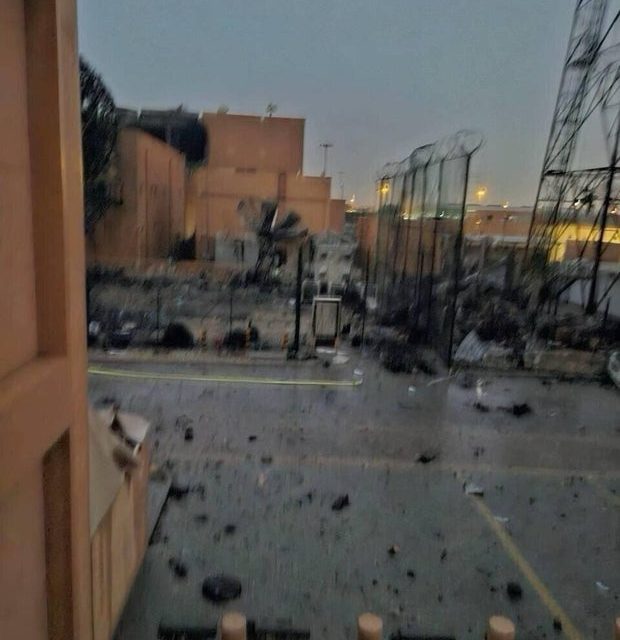
On the first day of the conflict, Iran launched an attack on the U.S. Navy’s Middle East headquarters in Bahrain. The assault occurred before all military families stationed there had been evacuated. According to several families, evacuation delays lasted about a week or more, creating a tense situation.
A military spouse expressed fear, recounting the sound of ballistic missiles during sleep. Multiple days of missile and drone strikes targeted Bahrain, highlighting the unexpected scale of these attacks. The U.S. government’s lack of early evacuation requirements caught many off guard.
The U.S. military anticipated some retaliation, evacuating headquarters buildings on the base. However, the magnitude was beyond expectations. Several military families remained living off the base during the attacks, with significant evidence of missile contrails and explosions.
No casualties among military personnel were reported, yet social media images depicted extensive damage. One image showed an explosion targeting a radar system on the war’s first day. Although the Pentagon has not disclosed damage costs, Acting Navy Secretary Hung Cao acknowledged the significant damage.
The Navy’s Fifth Fleet, headquartered in Bahrain since the 1990s, is vital for Middle East logistics. Serving over 8,300 personnel and their families, its operations significantly impacted naval logistics, including food shortages on the USS Abraham Lincoln carrier.
Resupply routes were rerouted to Diego Garcia, producing extended logistics cycles of 14 to 18 days instead of 5 to 7 days from Bahrain. Admiral Daryl Caudle, Chief of Naval Operations, noted adjustments in the Middle East logistics supply chain.
During a town hall, Caudle revealed retrieval efforts for belongings left behind due to current plans not returning to prior base operations soon. Options for shipping household goods and vehicles for members within and outside Bahrain were facilitated.
Financial Strain on Evacuated Families
About 1,450 members and families were evacuated since the war’s outbreak, facing financial strain while maintaining households in Bahrain and the U.S. The Pentagon offers benefits to assist, though claim processing takes significant time.
The Navy spokesperson outlined communication channels and relocation support for affected members, with a transition deadline by November for housing entitlements. Relocated families generally evacuated to Norfolk, Virginia or Tampa, Florida.
In Tampa, Blue Star Families supported evacuees by providing supplies such as backpacks, clothing, and kitchen implements. Executive Director Suzy Malloy praised U.S. Central Command’s efforts but acknowledged the evacuees’ ongoing uncertainty.
Challenges faced by families resulted in frustration with the broader situation. As the crisis prolonged, the military itself was not blamed for evacuees’ difficulties.
 Mayor Mamdani Responds to Netanyahu’s United Nations Speech
  British Prosecutors Charge Man with Terrorism Over Politician’s Murder
  Backlash Against Trump’s White House Photos
  State Department Accuses Senate Democrats of ‘Grandstanding’ Over Venezuela Oil Deal
  EU Plans Deportation of Rejected Asylum Seekers
  British Police Arrest Man Suspected of Terror Plot