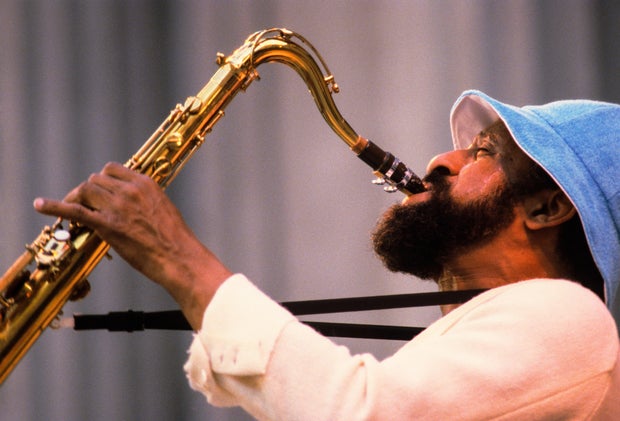
Sonny Rollins, a renowned tenor saxophonist celebrated for his bold and distinctive tone, passed away on Monday at the age of 95. Spokesperson Terri Hinte announced Rollins’ death at his home in Woodstock, New York, without specifying a cause of death. Rollins had been mostly housebound due to various physical ailments in recent years.
Early Life and Career
Theodore Walter Rollins was born on September 7, 1930, in Harlem, New York, into a musical family. His father played the clarinet, his sister the piano, and his brother a violin. Rollins was exposed to music early on, listening to performances at the Apollo Theater. He fell in love with the saxophone around the age of 11 and persuaded his parents to buy him one.
Despite financial difficulties, Rollins quickly taught himself and gained prominence in his teens. He joined Thelonious Monk’s band and performed with Miles Davis and Bud Powell, entering the recording scene before finishing high school.
Struggles and Recovery
Like many musicians of the time, Rollins faced challenges with heroin addiction, which led to two jail sentences in the early 1950s. He sought treatment in a hospital in Lexington, Kentucky, in 1954, and reflected later on the experience as a pivotal point in his life.
“I began to have a deeper philosophy of what life was about. From that point on is when my consciousness awoke,” Rollins said.
Artistic Evolution
Rollins joined the Max Roach-Clifford Brown quintet upon his recovery and recorded “Saxophone Colossus” in 1956, solidifying his status as a leading sax player. He experimented with different styles, notably with a pianoless trio on landmark albums like “Way Out West.”
At the height of his career, Rollins retreated for two years, practicing in solitude on the Williamsburg Bridge. This seclusion marked a time of personal growth, prioritizing artistic integrity over popularity.
Return and Legacy
Rollins returned in 1961, embracing free jazz, sparking division among fans. He toured Europe extensively and explored Zen Buddhism, taking another sabbatical. His return in the 1970s saw him hailed as a legend, and he gained mainstream recognition, including a Guggenheim fellowship and induction into the Downbeat Hall of Fame.
Throughout the 1990s and 2000s, Rollins released critically acclaimed albums and continued touring until pulmonary fibrosis prompted his retirement. He expressed a deep connection to music during outdoor concerts, feeling part of something beyond the audience.
Acknowledgments and Influence
Rollins received Grammy Awards in 2001 and 2006, affirming his influential contributions to jazz. He performed shortly after the 9/11 attacks, a concert urged by his wife and manager, Lucille, to reflect resilience in the face of tragedy.
His passing leaves behind a rich legacy. “After I get out of this planet I’m not going to have any say about what’s going on, so I’m not worried about that,” Rollins told the New York Times.
Rollins is survived by nephew Clifton Anderson and nieces Vallyn Anderson and Gabrielle DeGroat.
 Zoe Kazan’s Journey with ‘East of Eden’
  Pete Davidson Criticizes NYC Mayor Zohran Mamdani Over BQE Construction
  Chris Hansen Criticizes Hollywood’s Portrayal in ‘Primetime’
  Monet Mazur’s Home Targeted in Hollywood Hills Burglary Attempt
  Dwayne Johnson Pays Tribute to Late Wrestler Benjamin Satterley
  David Cerda Celebrates 25 Years of Stage Success with ‘Joan Crawford Goes to Hell’