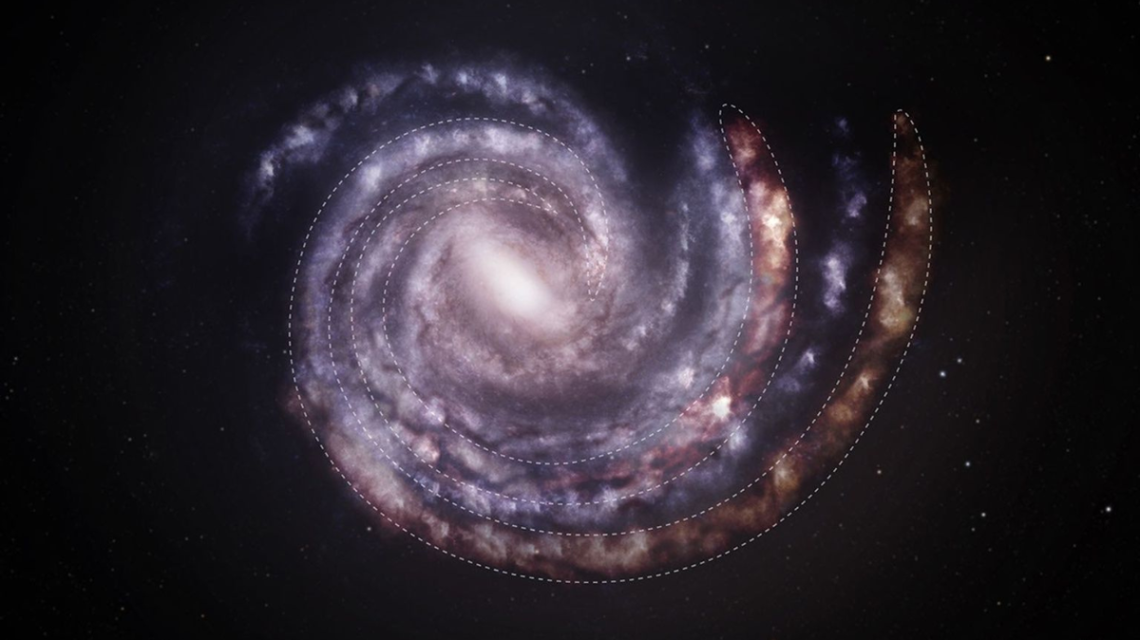
A group of astronomers has discovered that the spiral arms of the Milky Way galaxy extend much farther into space than previously thought. Using data from two powerful telescopes in orbit — NASA’s Chandra and the European Space Agency’s XMM-Newton — scientists made exact distance measurements of dust clouds in the galaxy’s arms.
The study relied on rare and powerful gamma-ray bursts from remote galaxies. As X-rays emitted by these bursts journeyed through the Milky Way, they reflected off dust clouds, producing rings measurable with exceptional precision. Beatrice Vaia, the Italian PhD student leading the study, noted, “This is a very direct way, relying only on geometry, to precisely measure distances to the Milky Way’s spiral arms.” Traditional methods, she explained, depend on assumptions about the galaxy’s rotation, which grow more uncertain in its outer regions.
Data revealed the dust cloud in the galaxy’s most distant arm has a width of approximately 3,500 light-years. While astronomers have recognized the Milky Way’s arms for over a century, mapping them remains challenging due to Earth’s position within one of the arms.
The breakthrough in using gamma-ray bursts sidesteps this issue and could significantly impact how we understand our place in the universe. Ilaria Fornasiero, a co-author and fellow PhD student, emphasized, “The differences are small, but any revision of these distances is essential because they are fundamental for understanding our galaxy. This could lead to revising estimates of the galaxy’s mass, which affects the extent of the arms.”
Despite the groundbreaking method, identifying suitable gamma-ray bursts remains challenging due to their rarity. Over the past 25 years, researchers have only found a few bright enough and correctly aligned to measure the Milky Way’s arms. Co-author Andrea Tiengo stated, “We will continue to be on the lookout for more.”
 Climate-Resistant Rock Glaciers: Hidden Water Resources
  California Voters to Decide on $7.5 Billion State Research Fund
  Ancient Pottery Unearthed During Roadworks in Tbilisi
  U.S. Space Academy Announcement
  The Need for New Strategies in Oregon’s Wildfire Management
  Plastic Pollution in the Great Lakes: A Growing Concern