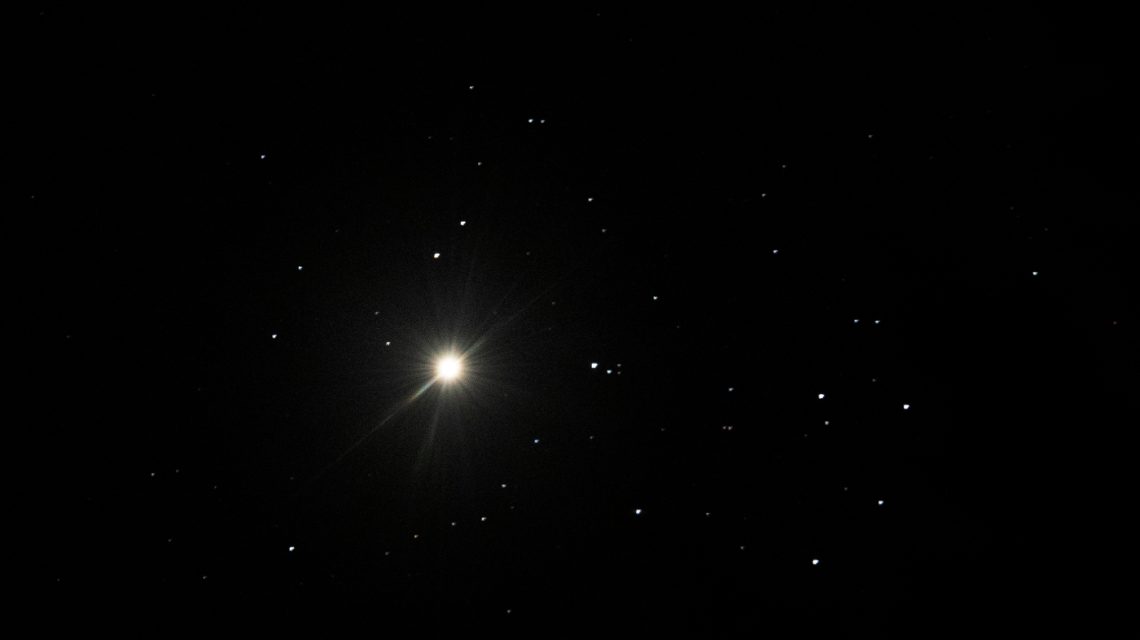
On April 3, 2020, the bright planet Venus appeared in conjunction with the Pleiades star cluster, seen from Olympia, Wash. This close alignment, known as the ‘seven sisters,’ happens approximately every eight years. While a subplot from Apple TV’s “Star City” involved a fictional Soviet mission to Venus in the 1970s, few people are aware that NASA considered a similar mission during the same period.
In the late 1960s, NASA explored various space mission concepts under the Apollo Applications Program. The program aimed to utilize Apollo/Saturn hardware for missions such as extended lunar stays and crewed space stations. Before the Apollo 11 moon landing, one idea included a Venus flyby mission. Such an undertaking was ambitious, given the limited technology and the unknown effects of long-term spaceflight on humans at that time.
Bellcomm, a subsidiary of Bell Labs, conducted a study on the Venus flyby concept for NASA. Kirk Sorenson, a nuclear and aerospace engineer, summarized this study on the Selenian Boondocks blog. The mission plan involved launching an Apollo capsule using a Saturn V rocket into low Earth orbit. An Environmental Support Module, replacing the lunar module, would provide equipment and consumables for the lengthy voyage.
The rocket’s third stage, the S-IVB, would propel the Apollo capsule and support module towards Venus. Leftover fuel would be vented into space. Astronauts would convert one of the fuel tanks into living space, a concept known as the ‘wet workshop.’ Solar panels on the S-IVB would supply power for the mission.
According to space historian Paul Drye, the astronauts would spend 123 days traveling to Venus. The spacecraft would pass 6,200 kilometers from Venus’ day side and then take 273 days to return to Earth, making the total mission last 396 days. At its closest point, the spacecraft would perform radar scanning and spectroscopic and photographic studies of Venus. An orbiter and 14 probes would be deployed. These included six atmospheric probes to study atmospheric density changes, four balloon probes for wind patterns, crash-landing probes for surface photos, and two soft-landers for soil and weather analysis.
The Apollo command module would return to Earth with an upgraded heat shield. Unfortunately, this Venus mission never came to fruition. Congress reduced NASA’s budget before the Apollo 11 landing, leading to the cancellation of the last three Apollo missions. The only successful Apollo Applications project was Skylab, America’s first space station, which operated in the early 1970s.
Although NASA, alongside other space agencies, has achieved uncrewed missions to Venus, human missions remain unfeasible. Findings from these missions reveal Venus as a planet with surface pressures 90 times that of Earth and temperatures nearing 880 degrees Fahrenheit. While many focus on the moon and Mars, the idea of a crewed Venus flyby is intriguing. A future mission using a SpaceX Starship with a crew and probes could be possible. Yet, without a plan for humans to land on Venus, motivation for a manned mission remains low.
Mark R. Whittington, a writer on space policy, explores these themes in his political study on space exploration. His works include “Why is It So Hard to Go Back to the Moon?” and “The Moon, Mars and Beyond.” His recent publication is “Why is America Going Back to the Moon?”
© 2026 Nexstar Media Inc. All rights reserved. This material may not be published, broadcast, rewritten, or redistributed.
 Climate-Resistant Rock Glaciers: Hidden Water Resources
  California Voters to Decide on $7.5 Billion State Research Fund
  SpaceX Successfully Launches Starship Flight 14 into Orbit
  Ancient Pottery Unearthed During Roadworks in Tbilisi
  U.S. Space Academy Announcement
  The Need for New Strategies in Oregon’s Wildfire Management