Today, two significant celestial events capture the attention of skywatchers. The annual Perseid meteor shower, widely regarded as one of the year’s finest, has been active since mid-July. It reaches its peak overnight from Wednesday to Thursday. In certain regions, particularly where the solar eclipse coincides with sunset, observers might spot meteors during the eclipse’s totality phase.
Under perfect conditions, such as clear, dark skies away from city lights, the Perseids can produce as many as 100 meteors per hour. These meteors are noted for their occasional fireballs, which are exceptionally bright and leave glowing trails as they burn up in the atmosphere.
Watching the Eclipse Online
If you are not located along the eclipse’s totality path or if poor weather obstructs the view, online streams offer an alternative. Several organizations will broadcast the event. NASA’s live stream begins at 1:15 p.m. ET, while the European Space Agency will start their YouTube live stream at 1:30 p.m. ET (7:30 p.m. CEST).
Understanding Solar Eclipses
A solar eclipse transpires when the sun, moon, and Earth align, causing the moon to block the sun’s light. During a total solar eclipse, this alignment brings darkness similar to dawn or dusk. The sun’s outer atmosphere, typically concealed by its brightness, becomes visible during the eclipse’s totality.
In a partial solar eclipse, the moon obscures part of the sun, creating an effect where the sun appears to have a segment missing. An annular solar eclipse occurs when the moon is at its maximum distance from Earth during alignment, resulting in the moon covering the sun partially and producing a prominent ring of light.
Event Preparations in Spain
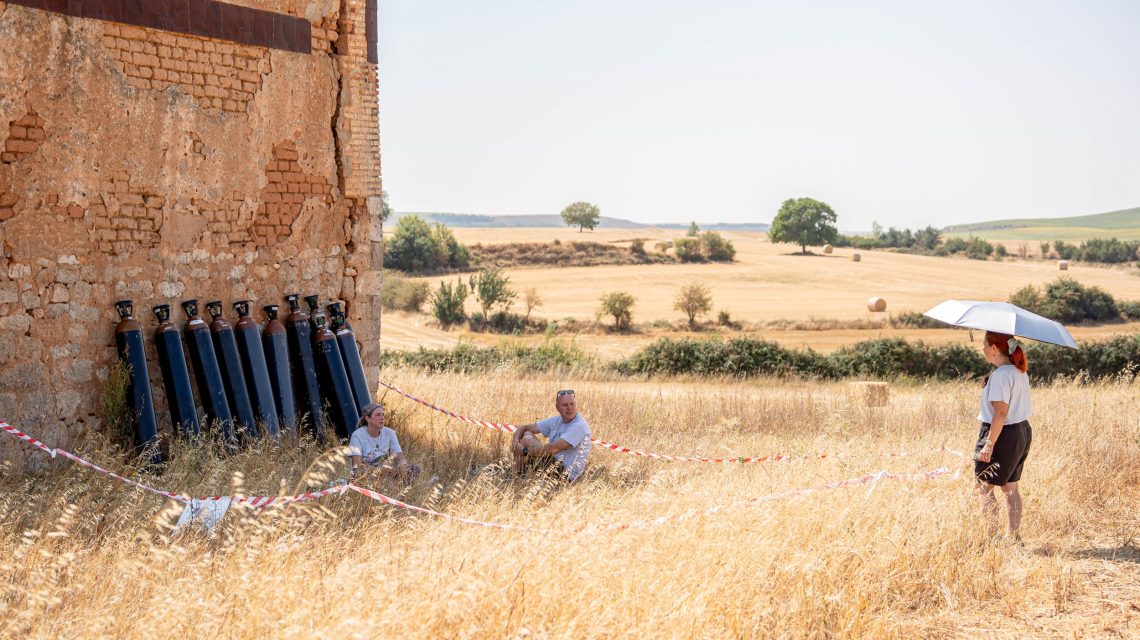
NASA is set to broadcast the eclipse from Villalibado, Spain. Photos show NASA personnel preparing by managing helium cylinders and setting up telescopes for the event.
Eclipse Draws Crowds to Europe
Around 450,000 tourists are expected to visit Spain, seeking optimal views of the first total solar eclipse visible from mainland Europe since 1999. The eclipse’s path of totality starts in Greenland, traverses Iceland, and continues to northern Spain. Spain anticipates economic benefits, with the government predicting a revenue of 347 million euros, or approximately $400 million, from eclipse-related tourism.
Excitement Across Europe
This total solar eclipse, a much-awaited event, will temporarily darken afternoon skies in Spain, Portugal, Greenland, Iceland, and northern Russia. It is the first time a total solar eclipse is visible from mainland Europe in over two decades. Most of Europe, as well as parts of Canada, northwestern Africa, and northern U.S. states, will observe a partial eclipse, assuming favorable weather conditions.
 The Threat of Melting Glaciers: A Call to Action
  Climate-Resistant Rock Glaciers: Hidden Water Resources
  California Voters to Decide on $7.5 Billion State Research Fund
  SpaceX Successfully Launches Starship Flight 14 into Orbit
  Ancient Pottery Unearthed During Roadworks in Tbilisi
  U.S. Space Academy Announcement