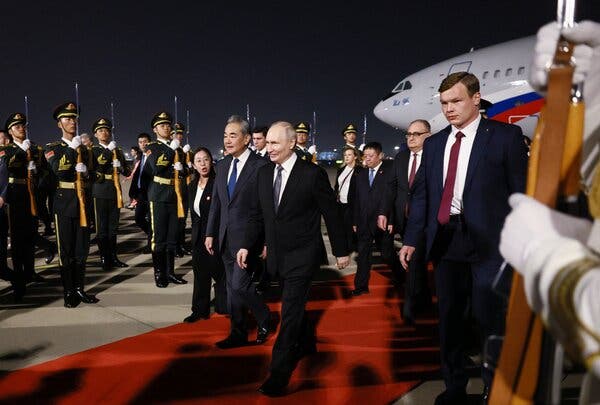
Amid disruptions in oil and gas supplies from the Persian Gulf, Russia is aiming to strengthen its energy relationship with China. This move comes as the Russian economy faces severe challenges and the military struggles in Ukraine. President Vladimir V. Putin arrived in Beijing on Tuesday for a state visit, highlighting Russia’s weakened position.
Putin’s visit underlines the strategic importance of China to Russia, especially when internal and external pressures are mounting. His army is facing difficulties in Ukraine, and Moscow is increasingly threatened by Ukrainian drone attacks. The prolonged conflict and its economic consequences are wearing down Russian morale.
Historically, Russia’s relationship with China has been marked by economic disparity. Aleksandr Gabuev, director of the Carnegie Russia Eurasia Center in Berlin, notes China’s significant leverage over Russia in their bilateral ties.
Despite these imbalances, Russia aims to avoid becoming a mere junior partner to China. With a nuclear arsenal larger than China’s, Russia sees itself as a crucial ally in global superpower dynamics, particularly concerning Taiwan. Its invasion of Ukraine has positioned Russia as a leader in an emerging non-Western alliance, with Beijing’s support.
Moreover, ongoing hostilities involving the United States and Israel against Iran open additional opportunities for Russia to assert itself on the world stage.
This visit to Beijing underscores its strategic need for cooperation with China, especially in the energy sector, amid the complexities of current global conflicts.
 British Police Arrest Man Suspected of Terror Plot
  Activists Push for Nationwide Ban on Child Marriage in the U.S.
  Investigation into Alleged Incident at Cornell University
  Rising Drone Threats Highlight Vulnerabilities in Moldova’s Airspace Defense
  Bolivia Faces Security Test Amid Unrest
  Incident on FlyDubai Flight Raises Security Concerns