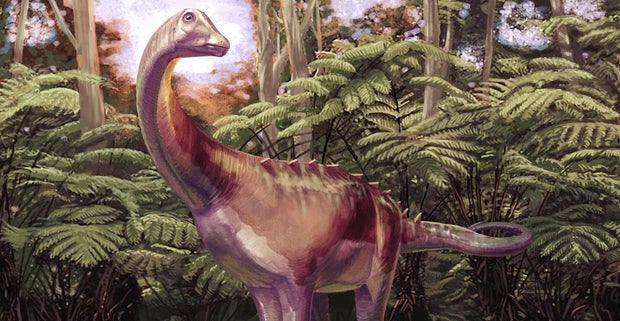
Scientists have found a rare dinosaur fossil from Antarctica that had been stored away for decades. The fossil is from the tail of a long-necked, plant-eating dinosaur known as a titanosaur. The specific species remains unidentified.
The fossil was originally discovered in 1985 during an expedition on James Ross Island, Antarctica. It was collected by geologist Mike Thomson, who was working with the British Antarctic Survey to map rock layers and collect marine reptile fossils for future dating research. He noted it as a large reptile find.
Decades later, paleontologist Mark Evans noticed the bone in the British Antarctic Survey’s collections. Suspecting it might be a dinosaur, Evans and other researchers analyzed the bone’s shape and compared it with other known dinosaur remains, confirming it as a titanosaur. This finding was published in the journal Acta Palaeontologica Polonica.
Dinosaur fossils are rare in Antarctica due to the harsh ice caps. Paul Barrett from the Natural History Museum in London commented on the past lush forests that existed there, making it very different from today. This discovery marks only the second known sauropod body fossil from Antarctica and the first dinosaur bone ever collected from the continent.
Titanosaurs lived in Antarctica around 80 million years ago, during a time when the region was forested. The dinosaur was approximately 23 feet long, smaller for its type, suggesting it could have been young when it died. Researchers believe its body may have drifted from the coast and sunk into the sea, becoming fossilized in marine rock.
Globally, over 100 species of titanosaurs have been identified. These dinosaurs are all four-legged herbivores with long necks and tails, aiding them in reaching trees for feeding. The largest titanosaurs reached lengths over 115 feet and weighed 60 tons.
Advancements in technology since the initial discovery enable researchers to closely examine bones to uncover detailed knowledge about ancient creatures. Although Thomson passed away in 2020, study co-author Evans expressed that Thomson would have been thrilled to know the fossil’s true nature.
This image provided by the Natural History Museum shows a fossil found in Antarctica that belongs to a group of dinosaurs called titanosaurs.
Source: Natural History Museum via AP
 The Threat of Melting Glaciers: A Call to Action
  Climate-Resistant Rock Glaciers: Hidden Water Resources
  California Voters to Decide on $7.5 Billion State Research Fund
  Ancient Pottery Unearthed During Roadworks in Tbilisi
  U.S. Space Academy Announcement
  The Need for New Strategies in Oregon’s Wildfire Management