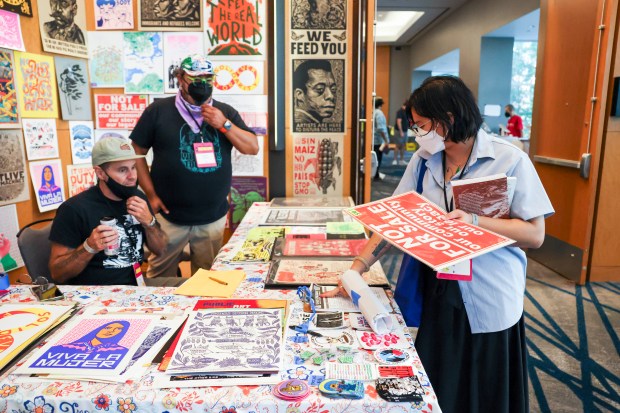
The Labor Day weekend in Chicago featured the 24th annual Socialism Conference, drawing about 3,000 attendees including socialists, radical activists, and community organizers. Hosted at the Hyatt Regency at McCormick Place, participants delved into strategies for empowering American workers and addressing class struggles.
The Democratic Socialists of America (DSA), under a banner reading ‘#TrySocialism’, expressed their vision of working towards an ideal horizon. The conference, now managed by Haymarket Books, was initially created by the International Socialist Organization in 2002, focusing on social justice and activism. Discussions over the four-day event covered diverse topics like rural organizing, protests against data centers and AI, fascism, health, and the resurgence of socialism’s core ideas.
Notably, the event highlighted historical figures like Eugene Debs, cofounder of the Socialist Party of America, and current inclusive movements as socialism gains traction. Haymarket reported the highest attendance yet, coinciding with a rise in socialism’s popularity as DSA membership reaches record levels and socialist candidates perform well in elections. Upcoming elections in cities like Los Angeles and Seattle anticipate significant socialist participation.
Vendors offered progressive literature and merchandise, with attendees like Ant Smith of Philadelphia’s W.E.B. Du Bois Movement School contemplating the moment’s significance. He noted a faddish view of socialism among some but emphasized a desire among participants to build lasting, equitable systems in response to billionaire-driven AI advancements.
Chicago organizers Asha Barnes and Rakaya Abda shared their cautious yet hopeful observations as first-time attendees. Initially skeptical, they appreciated the presence of diverse attendees and were inspired by speakers, particularly activist Angela Davis. While discussing reservations, they noted the perception of socialism as primarily represented by white activists, but saw a notable attendance of people of color.
Despite widespread skepticism about socialism, especially among older generations who link it to income redistribution, younger voters often associate it with economic equality. Republican gubernatorial candidate Darren Bailey capitalized on these perceptions, holding a press conference outside the event to highlight the conference’s controversial reputation.
Mel Bienenfeld, a retired teacher and longtime socialist, highlighted the internal conflicts within socialism about its political and ideological identity. The DSA, according to national co-chair Megan Romer, views the conference mainly as an educational venue rather than a recruitment hub, despite their image as an established group within the gathering.
Socialism’s turbulent history in the US includes notable movements in Chicago, from the Pullman Strike of 1894 to the founding of the DSA by Michael Harrington. The conference reflected the diverse beliefs within socialism, illustrated by lively debates and workshops where attendees explored union organization and conflict de-escalation in practical settings.
The event also embraced cultural expression, with sessions like musician Steff Reed leading group performances to foster solidarity and collective spirit. These activities encapsulate the conference’s promise of camaraderie among its participants.
 The Trump Team’s Challenge to the Military Leadership
  Maryland First State to Restrict Electronic Pricing in Grocery Stores
  Activists Push for Nationwide Ban on Child Marriage in the U.S.
  Democratic Hopes and Historical Warnings in 2026 Senate Race
  Republicans Face Challenges Amidst Cost of Living Concerns
  A Different Kind of Fall for Congress This Year