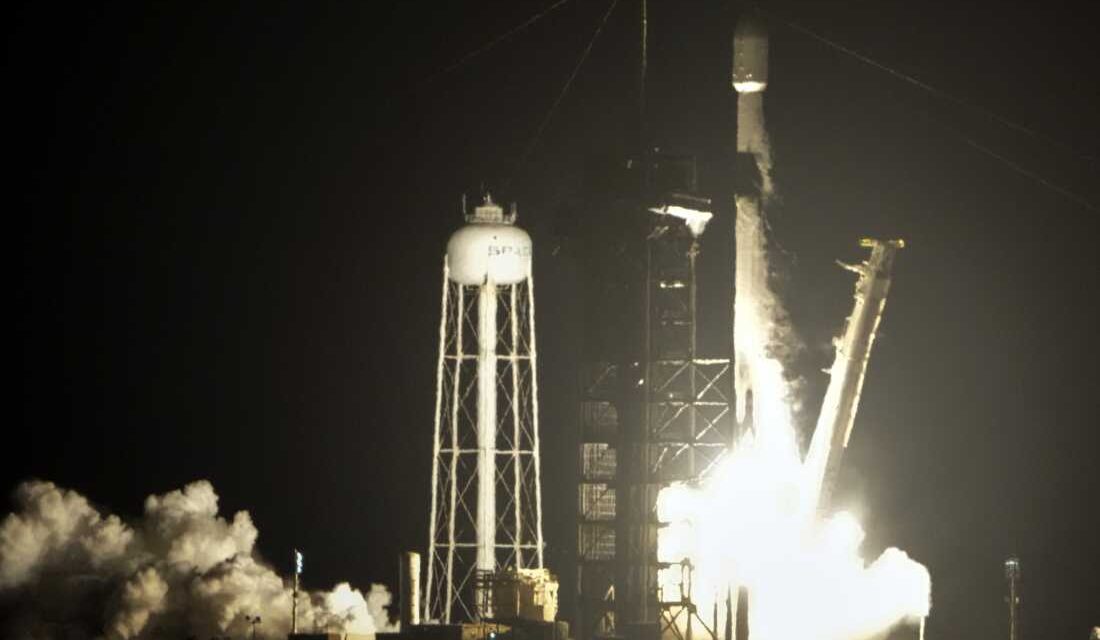
A segment of a SpaceX Falcon 9 rocket is predicted to collide with the moon shortly, according to scientists. Expected to happen around 2:35 a.m. ET, this piece will strike the lunar surface at a velocity exceeding 5,000 miles per hour. Bill Gray, who develops space object-tracking software, provided this analysis.
The fragment is part of the rocket’s upper stage and resembles a five-story building in size. It originated from the Falcon 9 mission that transported two lunar landers and scientific tools to the moon in January 2025. The anticipated impact site is on the moon’s sunlit side, visible from Earth, positioned in the northwestern region near the Einstein Crater, according to Gray. This collision is expected to carve out a crater at least 17 meters wide.
As explained by the Associated Press, SpaceX did not design the piece to crash into the moon. NPR attempted to contact SpaceX for comments but has not yet received a reply. Meanwhile, Brent Garry, a project scientist with NASA’s Lunar Reconnaissance Orbiter (LRO) at the Goddard Space Flight Center, said the orbiter would scout the region pre- and post-impact to examine any changes.
“After the impact, we might have a bit more information about the location. We can conduct further targeting approximately a week after and get precise data on the impact site,” Garry commented during a June session organized by NASA’s Solar System Exploration Research Virtual Institute (SSERVI).
The impact may not be directly observable, as some experts indicate that even telescopes might struggle to detect any dust plumes arising from the collision. Gray noted on his website that the rocks ejected could form a visible ‘plume’ against the dark background, but uncertainty remains.
For those equipped with appropriate telescopes and aware of the inherent challenges, this represents a unique opportunity to observe moon impacts. Ben Fernando, a postdoctoral researcher at Los Alamos National Laboratory, advised curious individuals to consider taking a look, though he noted that standard binoculars would not suffice.
 Climate-Resistant Rock Glaciers: Hidden Water Resources
  California Voters to Decide on $7.5 Billion State Research Fund
  SpaceX Successfully Launches Starship Flight 14 into Orbit
  Ancient Pottery Unearthed During Roadworks in Tbilisi
  U.S. Space Academy Announcement
  The Need for New Strategies in Oregon’s Wildfire Management