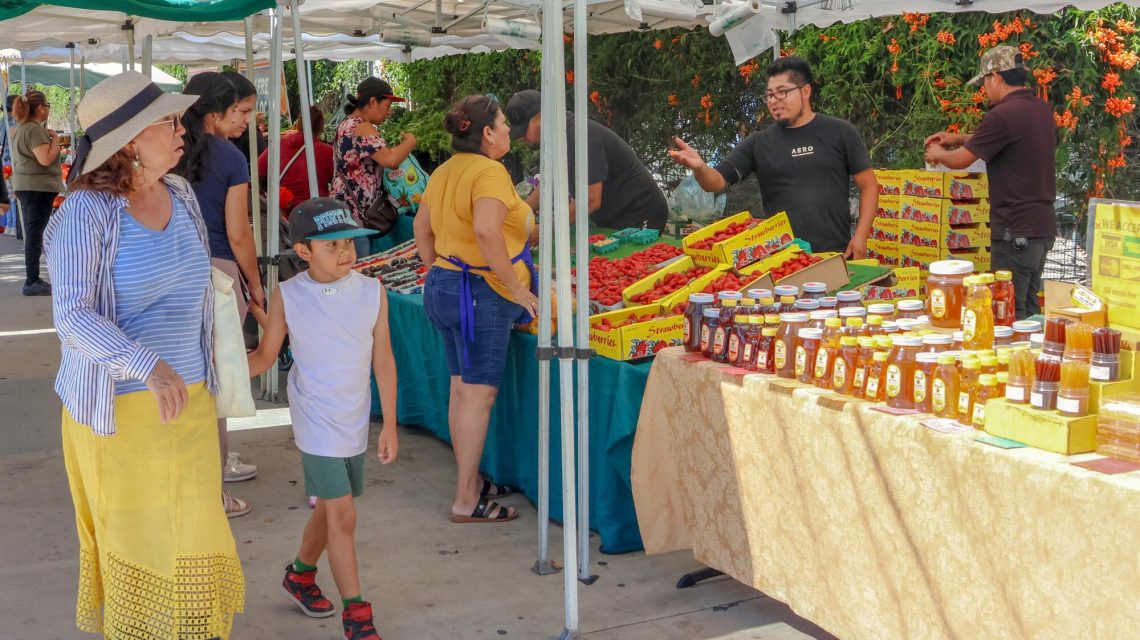
On a sweltering Thursday morning at Central Avenue Farmers Market, the usual bustle was accompanied by a sense of renewal. Families and children filled the area, with laughter and conversations in both Spanish and English creating a lively atmosphere. This day signified hope for a neighborhood rebuilding from past challenges.
A year ago, Immigration and Customs Enforcement (ICE) raids unsettled the South L.A. community. Market organizers decided to move the weekly event to a private, hidden courtyard away from the street. Alejandro Corona, the market manager, recalled a June incident that prompted their decision. “There was a lady actually coming out from the bus, she just walked down, and they took her,” he said. “Our customers were not feeling safe.”
Now, the market has regained visibility, adorned with colorful bilingual signs offering information on EBT, agricultural programs, and other social services. “Today we’re celebrating,” Corona mentioned, as refreshments were distributed among vendors as a gesture of gratitude amid ongoing uncertainties.
Shoppers browse the vendor stalls at the Central Avenue Farmers Market in Historic South-Central. (Nava Rawls / Los Angeles Times)
Federal Spending and Community Challenges
The neighborhood continues to face hurdles with changing federal policies. The Trump administration’s HR 1, or the “Big Beautiful Bill,” passed on July 4, 2025, resulted in substantial funding cuts to EBT, known as CalFresh in California. This law increased ICE’s budget to $85 billion, ranking it as the highest-funded federal law enforcement body.
In Los Angeles County, over a quarter of residents rely on CalFresh benefits. Recent federal cuts removed CalFresh support for various immigrant groups, including refugees and trafficking survivors. CIELO, an organization assisting Indigenous communities, reported persisting food insecurity challenges. Over 80% of Indigenous migrants surveyed struggled with food and housing affordability, compounded by language barriers.
“We’ve been seeing more people lining up when we give out food boxes,” remarked Janet Martinez, co-founder of CIELO. Since the pandemic, their attempts to distribute food faced limits, with only 150 boxes available weekly.
Market and Community Aid
Market vendors on Central Avenue play a vital role in supporting families. Yoana Luvian, a vendor selling Mexican food, drives from Lincoln Heights to the market. “The help here is essential for moms, single moms, and all trying to get by,” she commented, her daughter Sarahi by her side.
Markets offer programs like Market Match, doubling EBT benefits to extend food purchasing capabilities. “You get $10 [in benefits], they give you 10 extra,” Luvian explained. Others, like Blanca, come seeking additional resources due to ineligibility for federal aid. With family anxiety over immigration status, navigating benefits paperwork remains daunting.
Organizations like Food Access Los Angeles provide crucial aid. Jennifer Grissom, its executive director, highlighted the complicated procedures involved in CalFresh applications and recertification.
Broader Economic Impact
The CalFresh cuts affect vendors and farmers alike. Brian Griffith of Griffith Family Farms reported a 50% drop in profits since the cuts began. “Whatever [EBT] benefits they get trickle down to us,” Griffith explained. Bartering and longstanding customer deals have become commonplace, offering mutual aid.
Chef Amin Muhammad, from Crenshaw Food Hub, emphasized adaptable trading practices due to increased demands. He engages in bartering, such as exchanging locally picked lemons for other produce, signifying a community pulling together.
Future Challenges and Adaptations
Amid continuing restrictions, community members collaborate to meet resource needs. LaTonia Beason, a Leimert Park native, regularly visits food service programs and shares resources. Her collective action underscores the community’s resilience.
Upcoming in October 2026, additional CalFresh cuts will reduce federal contributions from 50% to 25%, shifting more costs onto states and regional organizations. Grissom anticipates “a huge loss for all our communities,” which increases confusion and anxiety for individuals and assistance organizations.
 Atlantic Ends September Without a Hurricane for First Time Since 1994
  Bobcat Sightings and Conservation Efforts in Illinois
  2026 El Niño: A Historical Comparison and Future Projections
  U.S. Records Warmest September in History
  Swiss Glaciers Show Effects of Ice Loss Amid Global Warming
  Climate-Resistant Rock Glaciers: Hidden Water Resources