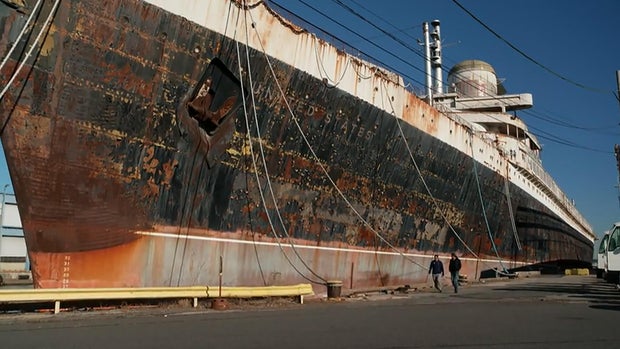
By November 8, 2026, the SS United States still captivates with her immense presence, even as the paint peels and rust accumulates. Measuring five city blocks long and 12 stories tall, this former queen of the North Atlantic remains a sight to behold.
Launched in 1952, the SS United States swiftly became the fastest ocean liner ever, clocking speeds exceeding 40 miles per hour on her inaugural voyage. Her unmatched transatlantic speed record still stands. Beyond her speed, she embodied elegance and sophistication. Throughout nearly two decades of service, she hosted four U.S. presidents, numerous celebrities, and countless passengers. Yet, the advent of the jet age rendered her glamour obsolete, prioritizing speed over leisurely sea journeys. By 1969, she was retired, left to languish in Philadelphia for nearly 30 years with few visitors.
Susan Gibbs, president of the SS United States Conservancy, shares an intimate connection with the ship. Her grandfather, William Francis Gibbs, designed the ship with military aid. The SS United States was more than a luxury liner; it was a strategic asset capable of transforming into a troop carrier in less than 24 hours.
Susan Gibbs notes, “Back then she was the space shuttle of her age.”
Today, only her structure remains. Her grand staircase stands bare, the salt-water pool echoes with memories, and the dance floor is a forgotten relic. Gibbs and others sought to preserve her through various projects, but none came to fruition. The ship seemed destined for scrap until an unlikely proposal emerged: transforming her into the world’s largest purposely-sunk artificial reef.
Alex Fogg, natural resources chief for Okaloosa County, Florida, outlines the plan. Sinking the ship would create a habitat for marine life. The county has successfully sunk smaller vessels to similar ends.
Despite her deteriorated state, the proposal to sink the SS United States stirred emotions. Jennifer Adams, the county’s tourism director, embraced the idea, seeing it as a unique attraction for tourists, although she was moved to tears by the decision’s harsh reality. The county acquired the ship for $1 million, with $13 million allocated for preparatory work. This included addressing environmental contaminants from the 1950s and modifying her structure for sinking.
As plans unfolded, supporters and fans mourned. Linda Sylva and Joe Beaman recalled fond memories aboard the ship, while enthusiasts like Jeffrey Smith traveled to bid farewell.
In 2025, crews towed the SS United States from Philadelphia to Mobile, Alabama. Despite challenges, she retained her grace, arriving early at her destination. There, significant remediation took place, ensuring her readiness for transformation.
If successful, the ship will be scuttled approximately 20 nautical miles from Pensacola, Florida. Her iconic funnels will find new purpose as museum pieces, preserving her legacy and artifacts.
Though her sinking seems paradoxical, the SS United States’ story will persist in maritime history. After years of isolation, she will foster life once more beneath the waves.
As Linda Sylva observed, the ocean now offers a welcome home, a fitting resting place for such a storied vessel.
 Scientific Debate Surrounds Mysterious Object Near the Sun
 Voyager 1 Reaches Light-Day Distance from Earth
 The Value of Kindness: New Research Insights
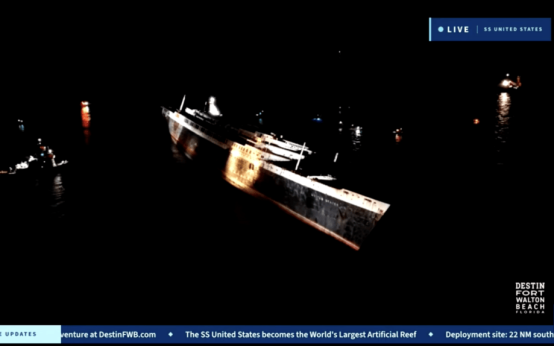 SS United States Transformed into World’s Largest Artificial Reef
 Mini-Moon 2026 QQ8 Temporarily Orbits Earth
 California Approves Proposition 38 for Health Research Funding