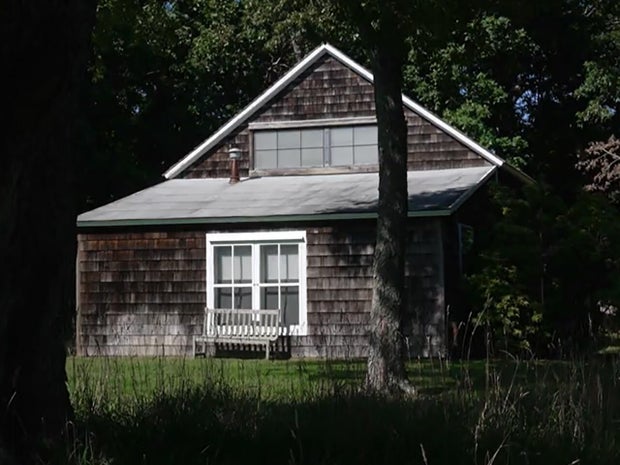
The Pollock-Krasner House and Study Center in Springs, New York, is a modest site with a significant history. This farmhouse on Long Island’s east end became a pivotal location when Jackson Pollock and Lee Krasner moved there in 1945. Although devoid of plumbing and heating, the couple chose this isolation to focus on their work, according to the Center’s director, Matthew K. Ward.
Now maintained by Stony Brook University, the site remains much as Krasner left it in 1984. One unique feature is a custom speaker system Pollock wired himself, covered in paint. Ward notes the pervasive presence of paint throughout their home, symbolizing their intense creative process.
“The way Pollock worked was so physical. I think we feel him through the floor,” said Ward.
Pollock’s innovative painting method broke conventional boundaries. Instead of using an easel, he crafted his masterpieces by stretching canvases on the barn floor, pouring and dripping paint. This rustic approach redefined art, leading Life magazine in 1949 to question if Pollock was the greatest living painter in the United States.
Despite achieving fame, many visitors to the Pollock-Krasner House still ask, “Who’s Lee Krasner?” A new exhibition at New York’s Metropolitan Museum of Art titled “Krasner and Pollock: Past Continuous” aims to answer this. Co-curator Brinda Kumar details how the show examines the couple’s careers together, highlighting the creative dialogue across their shared space.
Pollock, hailing from Cody, Wyoming, and Krasner, born to Jewish immigrants in Brooklyn, formed a unique partnership. Co-curator David Breslin suggests Pollock was drawn to Krasner’s intelligence and connections. Breslin believes that for Krasner, Pollock’s work was a puzzle she was eager to unravel.
Yet their relationship faced challenges, including Pollock’s alcoholism and affairs. Krasner herself remarked on the complexity of being married to Pollock, expressing both fortune and misfortune. By the mid-1950s, their marriage deteriorated, leading to Krasner’s move to Paris and Pollock’s tragic death in a car crash in 1956.
Following Pollock’s death, Krasner returned to Springs, took over his studio, and continued to promote his legacy while expanding her own work. Breslin mentions that Krasner, now free from marital constraints, developed large-scale paintings in the studio, such as “Through Blue” and “Combat.” Kumar notes that these paintings express a ferocity that is still visible in the remnants of her work today.
For 28 more years, Krasner lived at their home, filled with memorabilia of their shared life. Ward emphasizes Krasner’s desire for both her and Pollock’s legacies to endure together. The Metropolitan Museum’s exhibition strives to reframe Krasner as Pollock’s equal, altering the historical narrative surrounding their contributions to art.
The exhibition “Krasner and Pollock: Past Continuous” is an attempt to recalibrate the perception of these artists, celebrating Krasner’s contributions alongside Pollock’s. Breslin underscores the exhibition’s goal to present Krasner with equal regard, a significant shift in how these artists are perceived.
For more info:
“Krasner and Pollock: Past Continuous,” at the Metropolitan Museum of Art, New York City (through January 31, 2027)
Exhibition catalogue: “Krasner and Pollock: Past Continuous” by David Breslin and Brinda Kumar, available at major bookstores
Pollock-Krasner House and Study Center, Hampton, N.Y.
 Understanding Fear in Scary Movies
 Media Silence on Key Issues in Sports
 A Look Back at Chicago Events on October 19
 Lake Forest Preservation Symposium Celebrates Heritage and Community
 Potential Impact of AI on Fiction Writing
 Exploring the Museum of Bad Art