Reviving a Lost Vision
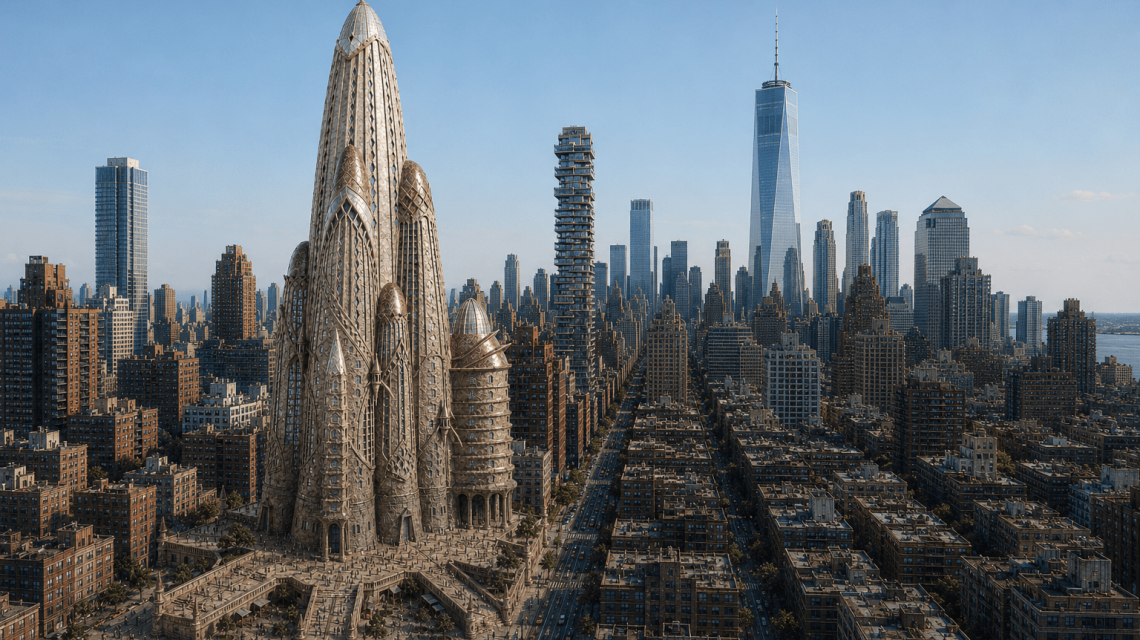
Antoni Gaudí’s dream of a New York City skyscraper, known as Hotel Attraction, has been given a new lease of life through detailed visualizations that showcase its incredible interiors. Daniel Coughlin, an architectural enthusiast, recreated this unbuilt Manhattan tower on his YouTube channel, The Curious Compendium of Architectural What-Ifs. Originally commissioned in 1908 by two unknown American businessmen, Hotel Attraction has sparked renewed interest, especially during the centenary of Gaudí’s death.
The Immense Scale
If constructed, Hotel Attraction would have soared to approximately 1,181 feet above Lower Manhattan, holding the title of the world’s tallest building for many years until surpassed by the Empire State Building in the 1930s. Coughlin’s latest work unveils not only the tower’s striking exterior but also its vast ceremonial halls, themed cultural spaces, and monumental interiors.
A Multi-Dimensional Experience
Coughlin described Hotel Attraction as more than a conventional luxury hotel, viewing it as a blend of a hotel, cultural complex, vertical city, and secular cathedral. Visitors would have entered through one of four monumental entrances leading to a richly adorned reception hall. The building would have been embellished with trencadís, a ceramic mosaic signature of Gaudí.
Each floor of Hotel Attraction was designed as a themed space reflecting different world regions. The first floor featured the America Room, followed by the Europa Hall, which combined dining, concerts, and theater settings. Higher floors were dedicated to Asia, Australia, and Africa, interspersed with museums, galleries, and leisure spaces.
Surprising Diversity of Functions
The range of functions within Hotel Attraction startled Coughlin. It was not merely a tower of bedrooms and restaurants; the lower towers included apartments and residences, while the central structure housed museums, theaters, galleries, and observation spaces. Kitchens, garages, and other essential services were planned for several underground floors.
Coughlin saw the building as a self-contained vertical world. Visitors would journey upward from practical spaces to increasingly ceremonial and celestial environments.
The Tribute to America Room
Near the summit was the Tribute to America Room, conceived as a vast chamber about 410 feet tall. Anchored by a 33-foot Statue of Liberty replica, it was surrounded by sculptures of the Founding Fathers, an American eagle, and other patriotic symbols. This immense room embodied the project’s ambition, blending hotel interiors with the grandeur of a secular cathedral dedicated to America.
Organic Architecture
Coughlin was captivated by the building’s architecture, which featured flowing columns, arches, and ceilings that blended seamlessly rather than appearing as distinct elements. This sculptural and immersive environment reflected Gaudí’s architectural principles.
The Exterior’s Unique Decoration
Unexpected discoveries in Coughlin’s research included the intended exterior decoration. The Hotel Attraction was to be adorned with Gaudí’s trencadís, transitioning from earthy greens at the base to silvers and golds near the summit, symbolizing a journey from earth to the celestial realm.
The Impact on Architectural Identity
Although never built, Coughlin believes Hotel Attraction could have transformed New York’s architectural landscape. The tower offered a new skyscraper model, replacing rigid forms with tapering, organic structures clad in mosaics, glass, and sculpture. He speculated it might have encouraged more expressive high-rise designs.
Had the tower survived, it would likely be one of New York’s most iconic landmarks, after Gaudí’s Sagrada Família in Barcelona.
 Readers React to Miss Manners Column
  Troy Swanson: Award-Winning Librarian Transforming Academic Libraries
  Lisdoonvarna Matchmaking Festival: A Unique Tradition
  Midwest Underground Railroad Network Gains National Recognition
  Art Collective Critiques Administration with Mall Installation
  American Hagwon: A Tale of Family and the Korean Diaspora