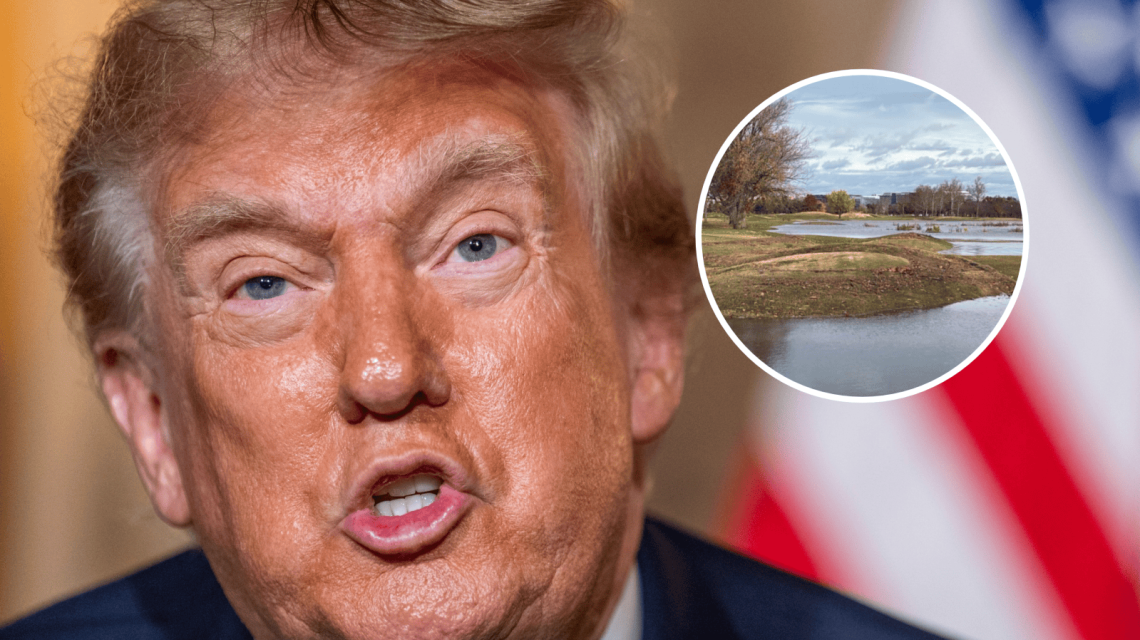
President Donald Trump announced on Saturday that a storm had severely damaged East Potomac Golf Links in Washington, D.C. The public course was flooded, and seawalls along the Potomac River collapsed. This destruction could impact an ongoing legal dispute involving the Trump administration’s plans to replace the historic complex with a championship golf venue.
Trump referred to the affected area as “Trash Island,” stating an “act of God” had caused the devastation, with eroding seawalls collapsing and sections of the adjoining road giving way. He claimed that the barrier needed significant elevation to safeguard the land and vegetation. Trump suggested divine intervention in overcoming a legal challenge posed by a judge against the golf course’s development.
There was no independent engineering report or damage estimate provided in Trump’s Truth Social post. The attached photo showed water surrounding trees but did not clarify the full extent of the damage.
Legal and Environmental Context
According to an October 13 court ruling by U.S. District Judge Ana C. Reyes, the National Park Service (NPS) previously removed 430 healthy, non-invasive trees from the golf course. Further tree removal was halted by Reyes to maintain public access to the park. Judge Reyes, appointed by President Joe Biden, issued this order to stop further destruction of the park’s natural resources.
On Saturday, Trump stated on Truth Social that the Department of the Interior (DOI) sought permission from Judge Reyes to commence the project immediately. However, no corresponding request was found in the latest court docket, last updated on November 27.
The president mentioned the possibility of appealing the legal dispute. Meanwhile, golf operations have ceased, and visitors face uncertainty regarding access to the federally managed Hains Point property.
The D.C. Preservation League, along with golfers Alex Dickson and Dave Roberts, filed a lawsuit against the DOI and NPS on February 13. Their case cites violations of several federal acts, including the National Environmental Policy Act and the National Historic Preservation Act. Allegations also include unauthorized dumping of materials and claims that congressional approval is required for the proposed redevelopment.
Conflict Over Tree Removal
The legal conflict escalated due to the hasty removal of over 400 trees, which Judge Reyes described as occurring at “breakneck speed.” In response, Reyes issued a preliminary injunction on October 26, preventing further removal or damage to trees. The ruling mandated a 10-business-day notice for irreversible alterations to the course, covering changes to vegetation, landforms, pathways, or structures.
Trump’s own statements complicated the government’s position, as he announced plans for immediate starts and a 15-month closure, contradicting claims by the Department of Justice of no final redevelopment plan.
Current Access and Operations
Before a planned closure on November 15, Reyes ruled for the park and course south of Buckeye Drive to remain open to the public until December 12. She extended her restraining order and scheduled testimony from the acting NPS director for December 8. Her judgment indicated that the plaintiffs had a strong likelihood of prevailing on some environmental claims.
The government was not mandated to operate golf facilities, leading to the National Links Trust ending its management role. Golfer access persisted, albeit with limited self-managed maintenance. Reyes’s order did allow for necessary repairs, including seawall work and addressing pressing dangers, with notice required for restricted access due to threats.
Implications of the Storm
The recent storm damage may affect the ongoing case. Evidence of collapsed infrastructure could necessitate immediate stabilization, but it does not guarantee approval for the proposed Fazio course. The government needs to prove which actions address immediate threats and conform to federal law.
In his Truth Social post, Trump speculated that Judge Reyes would eventually approve of the project’s outcome, hinting at potential appellate court involvement. Presently, the issue is determining whether the administration can validate the damage and its proposed solutions under federal regulations.
 The Silence of Women in Tech Regarding Jensen Huang’s Return
 Mother Protects Infant during Los Angeles Earthquake
 The Controversy Surrounding Lake Ontario’s Renaming
 Opportunities and Challenges in Recent Developments
 Catholic Dioceses Enhance Support for Retired Priests
 Marine Veteran Warns of Threats to Historical Monuments