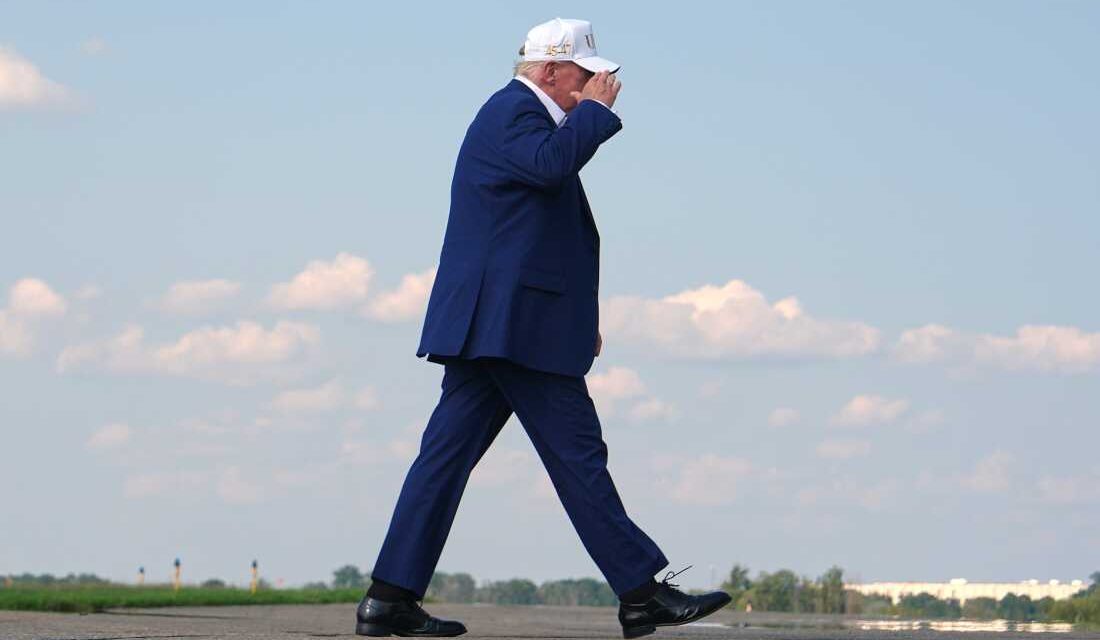
President Donald Trump recently emphasized his administration’s dual approach to ending the conflict with Iran, combining military action with economic strategies. The intent is to bring Iran closer to capitulating through economic strain after direct war efforts have pummeled its economy.
Trump asserts that Iran’s economy is faltering under intense pressure, essential for halting its nuclear ambitions and reopening the Strait of Hormuz. He also demands compensation from Iran amidst peace negotiations, reinforcing his stance that Iran is nearing financial collapse despite enduring years of sanctions.
Economic issues accompany the military ones. Trump believes the financial squeeze could lead Iran to reconsider its position. Inflation in Iran has reportedly surged to extreme levels, influencing the country’s ability to sustain operations. Trump noted that soldiers are unpaid, amid claims of inflation reaching 300%, although official estimates vary.
The U.S. facing its own economic challenges, fuel prices have fluctuated, following Trump’s comments on shipping restrictions through the Strait of Hormuz. This waterway once handled 20% of global oil shipments and is crucial in negotiations.
Whenever Washington proves itself incapable of pursuing diplomacy, it retreats into sanctions; and whenever those sanctions fail to produce results, it simply increases the dose,
stated Esmaeil Baqaei, from Iran’s Foreign Ministry. Baqaei warns that American reliance on sanctions could backfire on its own strategic interests.
Titled ‘Operation Economic Fury’, the U.S. Treasury Secretary Scott Bessent likens these economic measures to a financial bombing campaign against Iran. Blocking oil trade and imposing banking restrictions are focal points of the strategy.
Richard Nephew, a scholar at Columbia University, questions the effectiveness of these sanctions, critiquing the lack of a coherent strategy. Nephew argues that without defined objectives, Trump’s actions may weaken American bargaining power.
Despite these circumstances, Juan Zarate, former national security adviser, sees long-term benefits in applying economic and military leverage. Third-party countries also feel the impact as they face sanctions for dealings with Iran.
Trump flips previous administrations’ strategies, refusing their gradual methods in favor of assertive military and economic pressure. Historical sanctions dating back to 1979 are reviewed as insufficient, prompting his more direct approach.
Iran’s economy suffers substantial downturns, with indicators like barrels of oil exports drastically reduced. The U.S. economy, while growing, feels the sting of higher borrowing costs and inflation — factors affecting the domestic approval of Trump’s war efforts.
A senior U.S. official noted the military setbacks to Iran’s energy capabilities, reinforcing sanctions and naval strategies as productive tools. Trump believes U.S. citizens cope better with economic impacts than Iranians, leveraging America’s economic dominance.
Defense Secretary Pete Hegseth supports the economic pressure tactics, stressing the treasury’s power as a strategic tool against adversaries.
 The Trump Team’s Challenge to the Military Leadership
  Maryland First State to Restrict Electronic Pricing in Grocery Stores
  Activists Push for Nationwide Ban on Child Marriage in the U.S.
  Democratic Hopes and Historical Warnings in 2026 Senate Race
  Republicans Face Challenges Amidst Cost of Living Concerns
  A Different Kind of Fall for Congress This Year