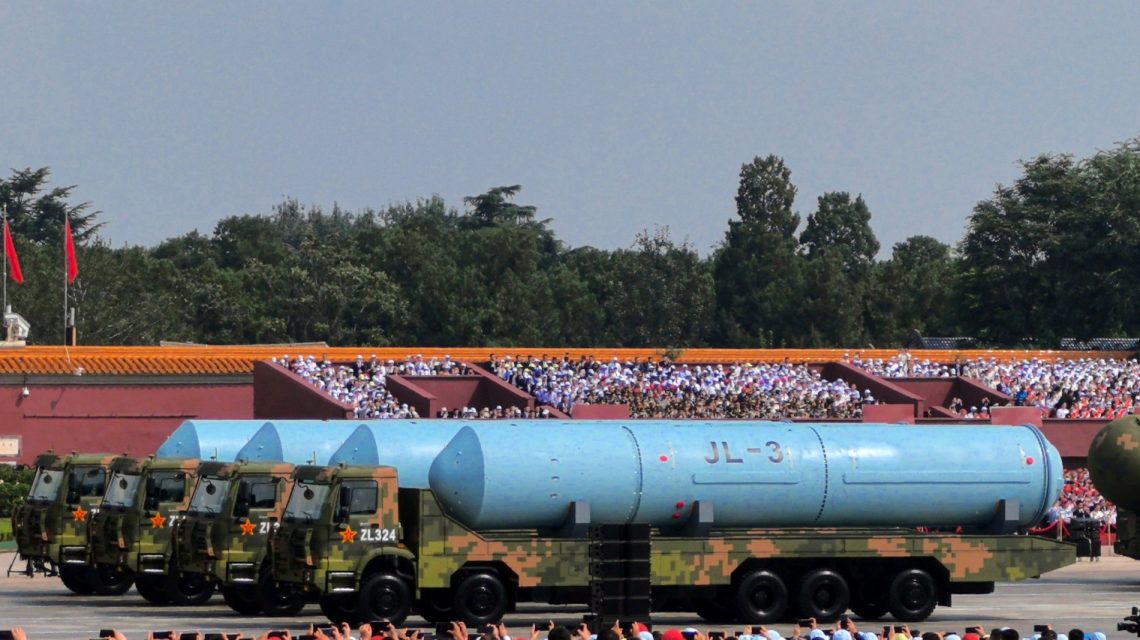
The United States, along with 40 other countries, has called for advance notification of missile launches following China’s recent test of a nuclear-capable missile. The test involved a submarine-based launch, speculated to be either a Julang-2 or -3 intercontinental ballistic missile (ICBM), with a dummy warhead. The missile traveled approximately 4,500 miles over the Pacific, causing unease among regional countries.
Treaty allies in the region, including Japan and Australia, labeled the launch as destabilizing. They noted Beijing’s insufficient notice of less than two hours prior to the test. The Marshall Islands and Palau, two U.S.-aligned Pacific nations, also voiced their protests by signing the statement.
The joint statement released on Tuesday highlighted that recent missile testing in the Pacific did not adhere to standard notification practices observed by most states for ICBMs, submarine-launched ballistic missiles, and space launch vehicles. It particularly emphasized that unannounced tests of nuclear-capable missiles are ‘dangerous’ and increase the risk of miscalculation. The statement urged all countries, especially nuclear-armed states, to provide at least 24 hours’ notice.
China responded with accusations of ‘double standards’ against Washington. During a U.N.-related disarmament conference in Geneva, U.S. State Department representative Victoria Nibarger’s criticism was addressed by China’s Ambassador for Disarmament Affairs, Li Chijiang. He asserted that China conducts its ICBM tests safely and responsibly.
Li claimed Washington engaged in ‘political manipulation’ and pointed out that China has conducted only three ICBM tests compared to the U.S.’s over 300. The ambassador questioned the U.S.’s authority to criticize China’s actions. However, experts highlighted differences in how the U.S. conducts its tests.
Robert Underwood, director of the Pacific Center for Island Security, noted that U.S. tests do not cross over island states as China’s test did. This difference is significant, he explained, as China’s actions aim to demonstrate its nuclear triad and counter-strike capability.
U.S. officials continue to express concerns over China’s rapidly expanding nuclear arsenal. The Stockholm International Peace Research Institute estimates this stockpile to reach at least 600 warheads by early 2025, up from around 350 in 2020. China has opposed U.S. proposals to join nuclear arms-limitation discussions, asserting its stockpile is minimal for defense and far smaller than that of the U.S. and Russia.
The Pentagon and Chinese Foreign Ministry were contacted via email for comments by Newsweek.
 Investigation into Alleged Incident at Cornell University
  Rising Drone Threats Highlight Vulnerabilities in Moldova’s Airspace Defense
  Bolivia Faces Security Test Amid Unrest
  Incident on FlyDubai Flight Raises Security Concerns
  Journalist Gershkovich Discusses Wrongful Detention and Release in Russian Prisoner Swap
  Pakistan Airstrikes in Afghanistan: Civilian Casualties Reported