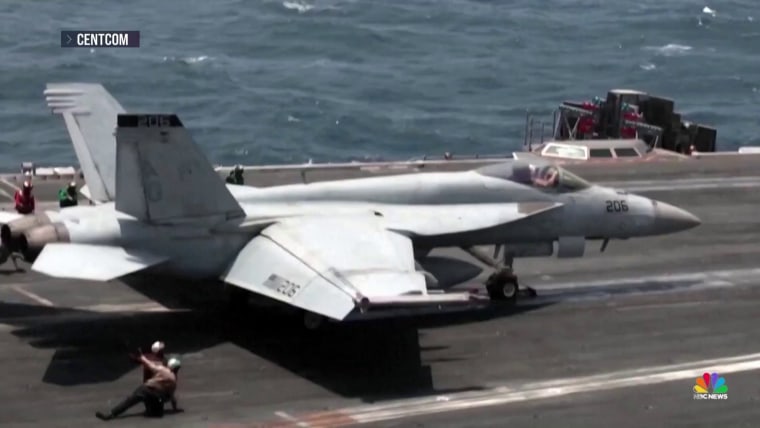
The U.S. military reinstated a blockade on Iranian ports early Wednesday, reacting to Tehran’s attacks on ships navigating through the Strait of Hormuz. This action has led to further strikes on nations hosting U.S. forces, as an interim agreement intended to end the conflict unravels. Iran’s retaliatory strikes across the Middle East, combined with both nations vying for dominance over the critical waterway through which a fifth of global oil and gas trade flows, heighten the risk of a full-scale war.
According to Iran’s Health Ministry, over 260 people were injured in the latest overnight strikes alone, signifying an escalation in the bombing. Iranian government spokesperson Fatemeh Mohajerani reported that over 30 individuals have been killed in ‘recent days,’ without further detail.
The U.S. imposed the blockade initially in mid-April and lifted it in mid-June, a day after an interim deal aimed at allowing 60 days for negotiations, particularly concerning Iran’s nuclear program. However, discussions have stalled amid intensifying conflict over the strait.
Iran’s paramilitary Revolutionary Guard declared its intent to halt all oil and gas exports from the Middle East in response to the blockade.
When President Donald Trump declared the blockade’s return on Monday, he mentioned a 20% fee imposition on ships using the strait. He later retracted this, following pleas from Persian Gulf allies. The U.S. resumed strikes alongside reinstating the blockade, hitting multiple targets, affirmed by Central Command on Wednesday.
Early Wednesday, missile alerts were activated in Bahrain and Kuwait due to incoming Iranian fire, adding tension to an already fragile ceasefire. Jordan also intercepted three Iranian missiles. Iran claimed responsibility for attacks on these countries.
“U.S. forces hold Iran accountable for unwarranted aggression endangering innocent lives,” stated U.S. Navy Adm. Brad Cooper, leading Central Command.
Trump warned in an interview on Tuesday that additional U.S. strikes were forthcoming unless negotiations restarted, potentially targeting critical infrastructures in Iran next week. Already, the U.S. has targeted at least one bridge.
There are at least 19 U.S. warships stationed in the Arabian Sea, two of which are aircraft carriers. Over a thousand Marines are on board an amphibious assault ship. Central Command noted hundreds of military aircraft stationed across the Middle East.
Since the U.S. and Israel launched military actions against Iran on February 28, Tehran has aggressively blocked the passage by targeting and threatening ships. This has spiked prices for oil, fertilizer, and other commodities. Recently, Iran has attacked ships on a route, near Oman and under U.S. oversight, causing renewed violence. Experts suggest reopening the strait by force requires a substantial naval presence and possibly thousands of ground troops.
Iran lost no time in denouncing U.S. operations, emphasized by its envoy to the United Nations, Amir Saeid Iravani, labeling the U.S. as the true aggressor.
Trump mentioned consultation from regional ‘kings and emirs,’ who proposed an alternative to charging passage fees through the strait in favor of investing billions into the U.S. Trump preferred this arrangement, indicating it aligned better with existing policies that keep the strait open without tolls.
U.S. Central Command confirmed strikes in Iran earlier on Tuesday. Iranian sources admitted the strikes but did not report damage or casualties. Later, the Iranian city of Bushehr faced multiple strikes. Explosions in Ahvaz and Bandar Abbas were also noted by state media Tuesday night.
These attacks hint at possible silent reprisals by Gulf Arab states against Iran. Separately, Kuwait announced an Iranian attack injured four of its naval personnel on Tuesday and caused a fire.
The interim deal covers free passage through the strait for 60 days without specifying future arrangements. Iran’s claim to regulate and possibly charge fees is contested by the U.S.
Following Trump’s announcement, the price of Brent crude briefly exceeded $87 per barrel before sinking to $78, far below the prices during peak wartime.
Regional mediators are still striving to bring Iran and the U.S. back into negotiations.
 British Police Arrest Man Suspected of Terror Plot
  Activists Push for Nationwide Ban on Child Marriage in the U.S.
  Investigation into Alleged Incident at Cornell University
  Rising Drone Threats Highlight Vulnerabilities in Moldova’s Airspace Defense
  Bolivia Faces Security Test Amid Unrest
  Incident on FlyDubai Flight Raises Security Concerns