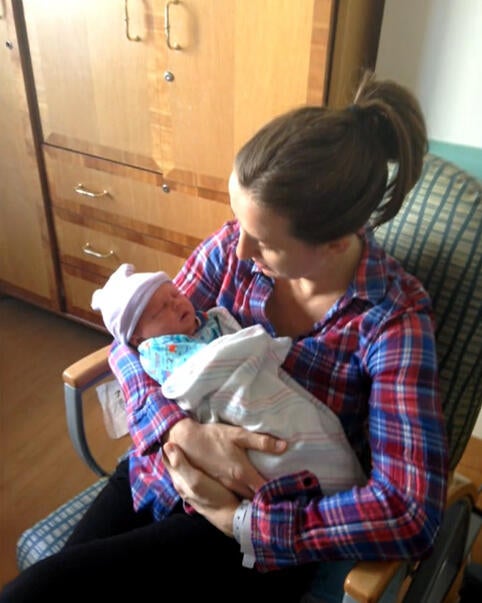
In December 2015, Meghan Cliffel’s life took a dramatic turn. A mother living in New York City, she returned to work eight months after her second daughter’s birth. Despite outward appearances, she struggled with inner turmoil. On December 4, she experienced a major shift, believing she was being watched. This marked the onset of postpartum psychosis, engulfing her in a delusional reality. She even started hallucinating, seeing and hearing terrifying things on the TV.
Her husband, Colin, described the escalating crisis as transforming her into someone utterly different. In the midst of her episode, she attempted to “rescue” their daughters, who were actually playing safely. The situation escalated to violence, prompting Colin to call 911. Meghan spent two weeks at Bellevue Hospital and later was diagnosed with postpartum psychosis.
“I had taken on a lot of work stress, and not quite feeling like myself, but outwardly, I was functioning well,” Meghan recalled.
According to Dr. Veerle Bergink, a psychiatrist with decades of experience in women’s health, postpartum psychosis is a psychiatric emergency. It is distinct from postpartum depression and can involve extreme symptoms like mania, psychosis, or severe depression, typically emerging within months after childbirth.
Dr. Bergink explains the rare and severe nature of the condition, which affects 1 to 2 women per 1,000 births each year in the U.S. Despite its historical presence, featuring in ancient Greek writings, research on this illness remains limited. Dr. Bergink emphasizes the lack of preventative research but assures that treatment can yield significant improvements.
The condition gained national attention during Lindsay Clancy’s trial. Accused of killing her three children under the influence of undiagnosed postpartum psychosis, her case ended in a mistrial. Prosecutor Jennifer Sprague questioned Clancy’s awareness of her actions, while her lawyer argued that her psychosis impeded her ability to distinguish right from wrong.
Dr. Jennifer Payne of the University of Virginia highlights the stigma surrounding maternal mental health in the legal context. She argues for mental health interventions over criminal proceedings for those suffering from postpartum psychosis.
Three years after her recovery, Meghan Cliffel and her husband chose to have a third child. Despite the one-in-three chance of recurrence without medication, Meghan took Lithium following her husband’s advice, culminating in a joyful period post-birth. Their son, now six, represents their successful journey through this challenging condition.
“It’s a real illness,” Meghan asserts. “There’s no shame. And you can get better.”
Postpartum psychosis, although devastating, is a condition from which recovery is possible with adequate time and attention.
If you or someone you know is experiencing a mental health crisis, you can contact the 988 Suicide & Crisis Lifeline by dialing or texting 988.
For more support, the National Alliance on Mental Illness (NAMI) HelpLine is available Monday through Friday, 10 a.m.–10 p.m. ET, at 1-800-950-NAMI (6264).
 Calm Parenting: Strategies to Manage Stress
  Trump’s Executive Order to Combat Mosquitoes and Ticks in D.C.
  Overcoming Weight Loss Challenges: Brain Health and GLP-1 Medications
  Supporting Children’s Mental Health at Home: Practical Steps for Parents
  Abdul El-Sayed’s Strategy to Attract Health-Conscious Voters in Michigan
  Preventable Infection-Related Cancer Cases Worldwide: Insights from IARC Study