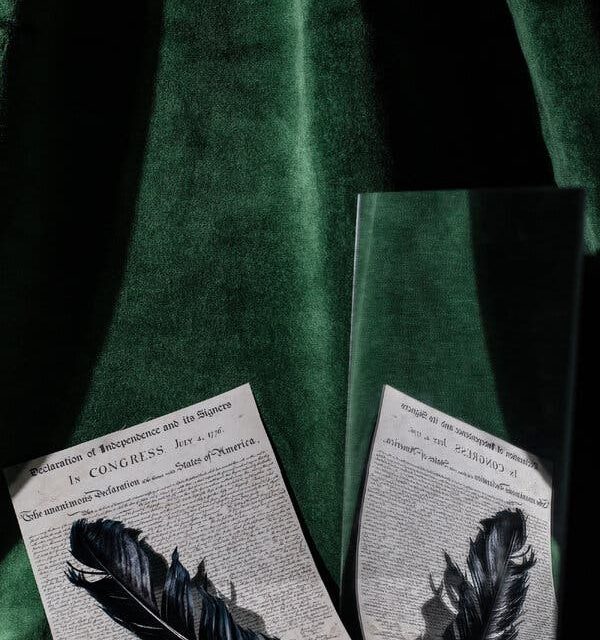
The Declaration of Independence holds a significant place in American civic tradition. It is often viewed as a sacred text with its compelling assertion of human equality: “We hold these truths to be self-evident, that all men are created equal, that they are endowed by their creator with certain unalienable rights, that among these are life, liberty and the pursuit of happiness.”
This statement reflects universal aspirations for human freedom. President Gerald Ford, during the nation’s bicentennial, referred to the Declaration as the unchanging “Polaris of our political order,” highlighting the eternal nature of its moral truths.
While many see the Declaration as embodying these ideals, history reveals a more complex story. Thomas Jefferson, its primary author, intended it less as an affirmation of equality and more as a critique of political authority. Influenced by Enlightenment thinkers like John Locke, Jefferson’s work emphasized the conditions necessary for government and the right of revolution, rather than a blueprint for emancipation.
“The opening assertions of ‘self-evident’ truths concern men in a ‘state of nature’ before government was established,” historian Pauline Maier wrote in American Scripture: Making the Declaration of Independence.
In this context, equality was understood as the absence of authority based on heredity or divine right. Jefferson echoed a widespread Revolutionary-era belief that was accessible to colonists through sermons, newspapers, or textbooks, as Maier noted. This ideology is evident in Thomas Paine’s work, Common Sense, where he argued against the idea of hereditary privilege just months before the Declaration was signed.
 The Trump Team’s Challenge to the Military Leadership
  Maryland First State to Restrict Electronic Pricing in Grocery Stores
  Activists Push for Nationwide Ban on Child Marriage in the U.S.
  Democratic Hopes and Historical Warnings in 2026 Senate Race
  Republicans Face Challenges Amidst Cost of Living Concerns
  A Different Kind of Fall for Congress This Year