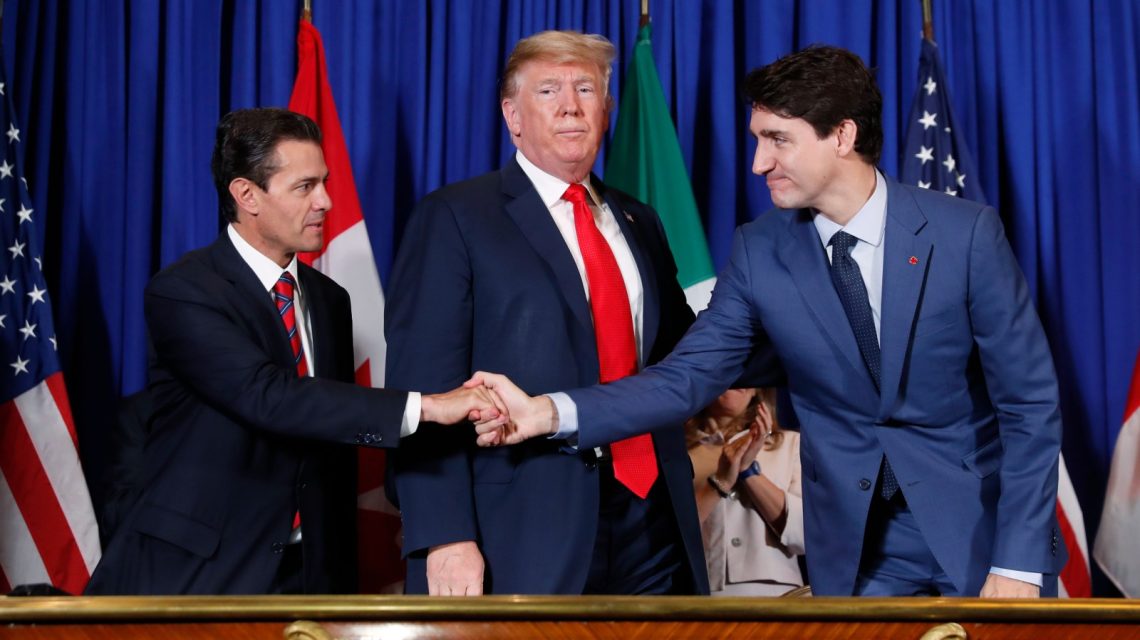
Officials from the U.S., Canada, and Mexico continue to negotiate the terms of the United States-Mexico-Canada Agreement (USMCA) after Washington opted not to renew the deal in its current form. Much of the ongoing dialogue surrounds tariffs, rules of origin, and the bargaining power of each country. This focus on trade metrics is common in such negotiations but might miss a more critical question.
The true issue extends beyond gaining concessions or favorable tariffs. It’s whether the U.S. may be undervaluing a cornerstone of its economic and strategic prowess. North America, comprising Canada, the U.S., and Mexico, has long been a significant economic triumph. Together, they built integrated supply chains and expanded cross-border investments, achieving economic cooperation uncommon elsewhere. This success stemmed not just from reducing tariffs, but from creating robust institutions that assured businesses, investors, and workers of stable governing rules over time.
While Washington’s choice doesn’t end the USMCA, it introduces uncertainty into the framework that has supported North American integration for decades. The ongoing negotiations could lead to a stronger agreement; however, legal and institutional uncertainties persist.
As a lawyer, I prioritize institutions over outcomes. Trade agreements often revolve around tariff schedules and technical rules, yet they also symbolize legal commitments. Their main value lies in fostering predictability. Although markets adjust to regulations or increased tariffs, uncertainty poses a challenge for businesses. Companies invest billions in infrastructure and supply chains only if they can rely on a stable legal framework for future decades.
This predictability is one of North America’s underrated competitive advantages. I have witnessed it firsthand from both U.S. and Canadian perspectives. Teaching law in the U.S. while having strong ties in Canada, I’ve observed how institutional stability, more than political agreements, is key to North America’s success. Governments change, elections alter priorities, and trade disputes occur. Although, investments persist due to the anticipation that the foundational framework will withstand political shifts.
This trust extends to the entire continent. American manufacturers depend on Canadian energy and Mexican production. Canadian businesses rely on the U.S. market, and Mexican manufacturing plays a crucial role in North American supply chains. Decades of investment reflect a belief in a more predictable North American business environment.
The opening of the Gordie Howe International Bridge showcases this principle. Conceived not just as an infrastructure project, it represents an investment in a unified North American economy. This bridge aims to facilitate significant commercial traffic through the Windsor-Detroit corridor, a major trade gateway. However, rather than merely celebrating economic cooperation, disputes over tariffs, tolls, and broader trade topics emerged. While the bridge will enhance goods movement, its ultimate success hinges on the stability and predictability of associated legal and political frameworks.
Predictability gains importance as the U.S. aims to lessen China dependence, boost domestic manufacturing, and secure resilient supply chains. These targets enjoy broad support, raising pertinent questions about the predictability of the framework supporting North American integration.
Every administration holds the right and duty to negotiate in national interest, with Canada and Mexico doing the same. Vigorous negotiation isn’t the issue; uncertainty as a strategy might be. Such uncertainty doesn’t yield immediate costs; instead, businesses might delay investments or diversify risks. Governments may also hedge and devise contingency plans, doubting today’s framework will last. These subtle shifts affect investment decisions, supply chains, and strategic planning over time, influencing allies’ trust in American institutions.
This negotiation influences more than just a trade agreement’s future. It determines whether the U.S. continues to value predictability as a strategic asset. Historically, the U.S. derived strength from building trustworthy institutions guiding long-term cooperation and providing strategic advantages, beyond economic or military might.
Unlike China, the U.S. benefits from neighboring democratic markets, flourishing from decades of legal collaboration and mutual investments. Geography granted the U.S. proximity to Canada and Mexico. Institutional endeavors transformed geography into a prime competitive edge.
The ongoing USMCA discussions will shape more than trade agreement futures, guiding whether the U.S. regards predictability as an enduring strategic asset.
 Dutch Review Board’s Euthanasia Ruling and International Debate
  Israeli PM Commends Heroic Actions in Flight Emergency
  Rabbi and Jewish Leaders Criticize Adam Brody for ‘Genocide’ Comment
  Flydubai’s Emergency Landing Highlights Cockpit Security
  Former Israeli PM Naftali Bennett Commends Passengers and Crew for In-Flight Heroism
  Diplomatic Complexities Unfold at U.S. National Archives Visit