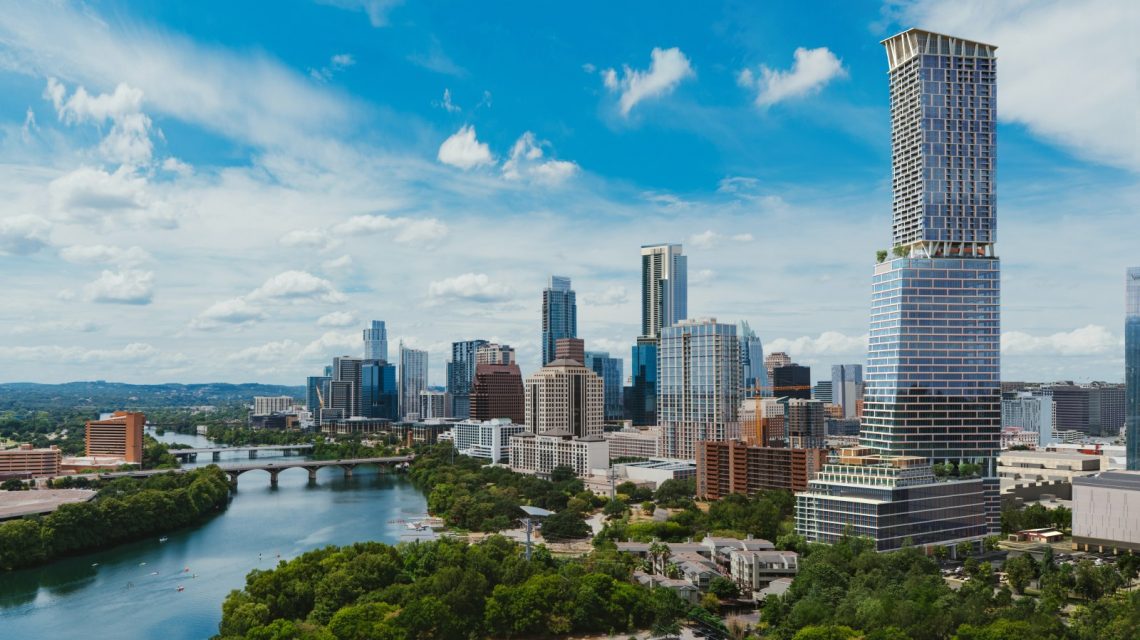
The city of Austin has achieved a new architectural milestone with the naming of Waterline as the tallest skyscraper in Texas. This 74-story tower, standing at 1,025 feet, has become the tallest building in the Southern United States. The assertion is backed by data from The Skyscraper Center of the Council on Vertical Urbanism, which lists completed buildings nationwide.
Seth Johnston, Lincoln Property Company’s executive vice president, confirmed to Newsweek, “At 1,025 feet, Waterline is the tallest building in Texas. We’re not aware of any buildings in the south that are taller.” The global architectural firm Kohn Pedersen Fox (KPF) designed this building. KPF is renowned for designing major structures like the One Vanderbilt in Manhattan and the Hudson Yards development in New York City.
The skyscraper, co-developed by Kairoi Residential, was completed in August, two months earlier than planned. Waterline serves multiple purposes: its top 33 floors hold 352 residential units, while a 252-room hotel occupies 13 floors—the newly opened 1 Hotel Austin. Since mid-August, residents have started moving in. As for office space, the building contains 24 floors awaiting lease.
“High Office Vacancies and America’s Aging Building Stock”
This unveiling of Waterline coincides with notable office vacancy rates across Texas cities, a trend intensified by the post-pandemic era. In March 2024, Austin was reported to have a 25.2 percent office vacancy rate, the third highest among the nation’s 50 largest metro areas, exceeding the national rate of 19.6 percent, according to Moody’s data.
Houston and Dallas surpassed Austin in vacancy rates. Architect Gordon Gill, associated with the ongoing construction of the Jeddah Tower in Saudi Arabia, remarked on architecture’s future in Newsweek, emphasizing the value of existing buildings over new heights. Gill advocates for refreshing current structures to maintain relevance and sustainability.
The American Institute of Architects (AIA) suggests that half of America’s 125 million buildings are over 50 years old. Reusing existing buildings reportedly prevents 50-75 percent of carbon emissions compared to new constructions. The AIA emphasizes, “The reuse and retrofit of older and historic buildings avoids the release of embodied carbon emissions.”
“A New Gateway to Austin’s Historic District”
Waterline’s title as the tallest building is temporary. In 2028, the Waldorf Astoria Hotel & Residences Miami will surpass it at 1,049 feet, as confirmed by the developer last May. Despite the pride in Waterline’s height, Johnston emphasizes the long-term benefits and quality impact on the area rather than just its towering stature.
Situated between Waller Creek and the Rainey Street historic district, Waterline offers views of Lady Bird Lake. Johnston describes it as a prime location in Austin—historically less accessible compared to other downtown areas. Waterline aims to be a new passageway from Austin’s central business district to the Rainey Street Historic District. The development incorporates two pedestrian bridges over the creek and adds three more public pedestrian and bike access points to the Waterloo Greenway.
 U.S. Records Warmest September in History
  Swiss Glaciers Show Effects of Ice Loss Amid Global Warming
  Climate-Resistant Rock Glaciers: Hidden Water Resources
  Senators Reach Bipartisan Agreement on Permitting Reform
  Experts Warn of Critical Period for the Colorado River
  Future Cities: Ambitious Projects Aiming for Innovation and Sustainability