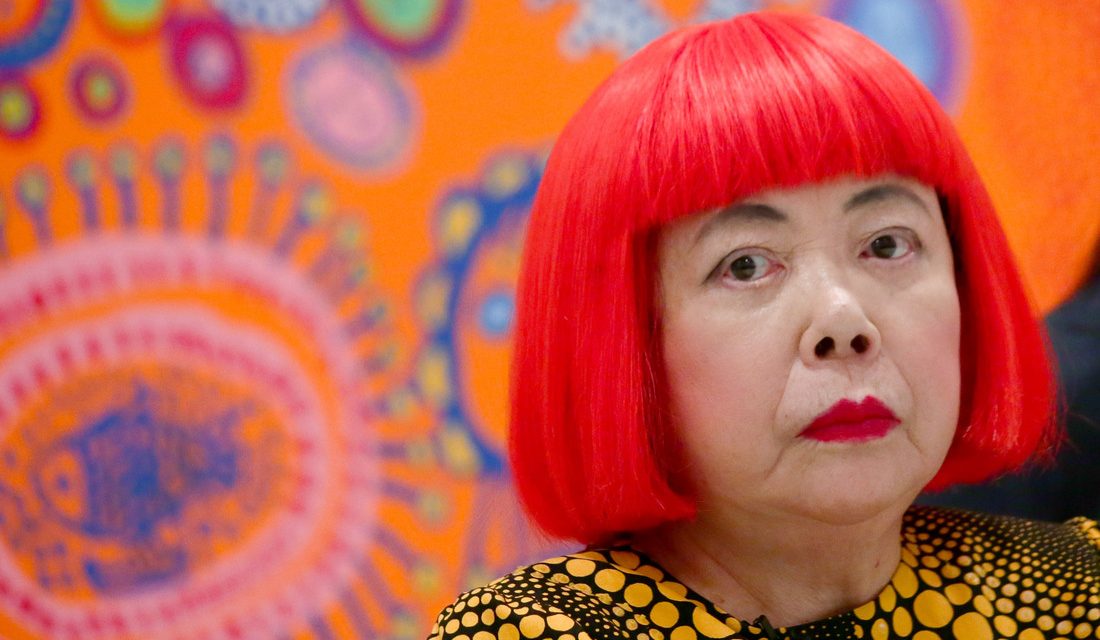
Yayoi Kusama, the acclaimed Japanese artist, known for her vibrant polka dot sculptures and captivating Infinity Rooms, has died at the age of 97. Her representative, David Zwirner, announced that Kusama passed from multiple organ failure on August 14 at a Tokyo hospital.
Kusama’s innovative art was an outlet for her obsessions, showcasing repetitive brushstrokes on dotted canvases labeled infinity net paintings, oversized polka-dotted pumpkins, enclosed mirrored rooms, and fluorescent pictures. She viewed her art as a survival tool, offering viewers a perspective on their place in a vast universe. Her statement, “Our earth is only one polka dot among a million stars in the cosmos,” captures this sentiment.
Born in Matsumoto, Central Japan, Kusama grew up with her family who owned a seed nursery. During WWII, she worked in a parachute factory as a child. Throughout her life, Kusama experienced hallucinations and used drawing to manage these episodes. Her mother often disapproved and confiscated her supplies. Inspired by a book of Georgia O’Keeffe’s paintings, she reached out to O’Keeffe for advice. O’Keeffe warned of the challenges of making a living as an artist in the U.S. but encouraged her to exhibit her work widely.
Kusama moved to New York in the late 1950s and became a part of the city’s avant-garde art scene. During the Vietnam War, her public happenings involved protestors covered in polka dots, distributing her open letter to President Nixon. Kusama proposed an imaginative pact to Nixon, advocating peace through art, not violence.
Richard Castellane, Kusama’s dealer in the 1960s, remembered her innovative Infinity Rooms filled with phalluses or blinking colored lights set to a Beatles soundtrack. These rooms, with mirrors that created an infinite space, mesmerized audiences with their novelty.
The challenges of gaining respect as a female artist in a male-dominated art world were considerable. Curator Mika Yoshitake recounted that Kusama was often exoticized for her style, but she embraced this distinctive presentation.
Kusama returned to Japan in the early 1970s, living in a psychiatric institution while continuing her art in a nearby studio. Her global popularity grew with exhibitions in prestigious venues like the Smithsonian’s Hirshhorn Museum and the Tate in London. In 2017, the Yayoi Kusama Museum opened in Tokyo, celebrating her contributions to the art world. Her designs have featured on items from cellphone cases to luxury products.
For Kusama, art was more than a career; it was essential to her existence. She hoped that future viewers would appreciate her work, stating, “If, a hundred years from now, someone were to see my art and think ‘Kusama did some really good work,’ I would be satisfied. Art, for me, is a creed.”
 Midwest Underground Railroad Network Gains National Recognition
  Art Collective Critiques Administration with Mall Installation
  American Hagwon: A Tale of Family and the Korean Diaspora
  Volunteer Enthusiasm Shines at Frank Lloyd Wright Home and Studio
  Bible’s Role in Times of War
  Arrival of Giant Pandas in Atlanta Marks Historic Agreement