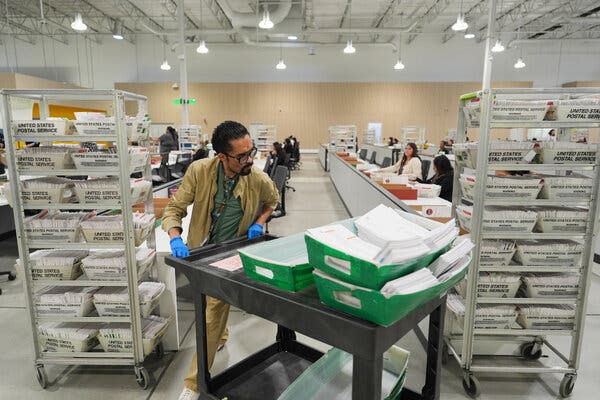
Four days after California’s primary election, officials have managed to count only about two-thirds of the votes. The outcomes for significant races like those for governor and Los Angeles mayor remain unclear. This slow counting process can be puzzling to many Americans and has left the Democratic-led state open to baseless fraud claims from Republicans.
California’s delayed vote count is a topic explored after every election. The state emphasizes mail-in voting, which slows the process because verifying signatures, opening envelopes, and examining ballots take time. California aims for a thorough process that prioritizes both voter accessibility and election security.
When voters submit their ballots in the final days leading up to the deadline, it inundates election offices with a surge of envelopes that require careful processing. Kim Alexander, president of the nonpartisan California Voter Foundation, describes this surge as a ‘pig-in-the-python’ effect, highlighting the heavy volume of mail-in ballots received on Election Day.
Other states like Colorado, Arizona, and Washington also engage in extensive mail voting but have found ways to securely process ballots more quickly. These states have adopted measures that allow them to deliver faster results. This raises the question of why California has not implemented similar strategies for quicker vote counting while maintaining security.
 Cornel West and Sean Hannity Discuss Differences on Podcast
  Trump Unveils AI-Powered America.gov Platform
  Upcoming Congressional Elections: Key Districts to Watch
  President Trump’s Pre-Midterm Interview on Key Issues
  Trump’s 2024 Reelection and Evolving Voter Dynamics
  Defense Secretary Emerges as Key Player in the Trump Administration