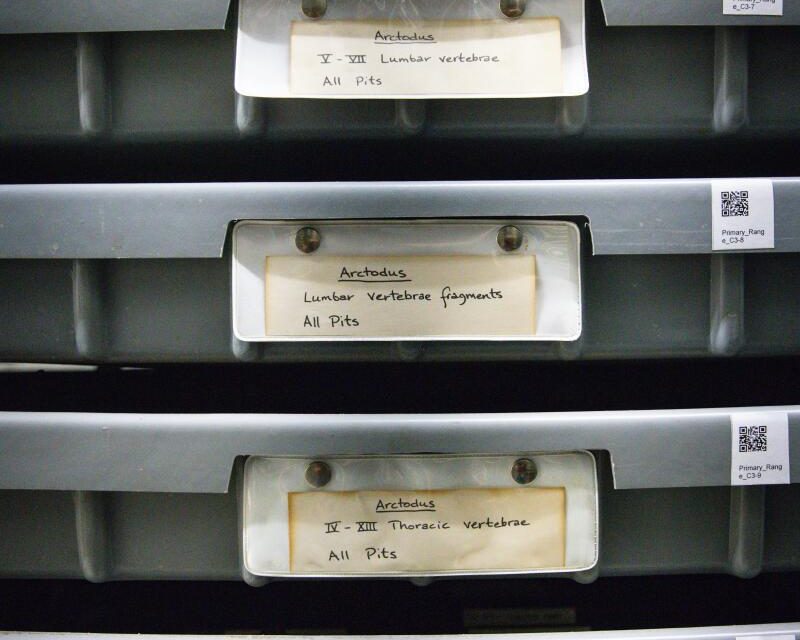
The La Brea Tar Pits are currently transforming as preparations for a significant renovation have begun. In the back rooms, packing crates tagged with notes like “bison skulls” or “camel hip” are everywhere. Every bone, from sloth jaws to sabertooth fangs, needs careful packaging in custom foam shells. This includes numerous ancient vertebrae, destined for storage, cataloging, and crating over the next two years.
On July 6, the Tar Pits will close to enable a complete renovation. When it reopens in summer 2028, the redesigned Hancock Park museum will be the heart of the Samuel Oschin Global Center for Ice Age Research. This research hub will focus on Ice Age history well-preserved here more than anywhere else globally. The new design will largely follow the existing building’s layout. It aims to better exhibit the collections and demonstrate what these preserved ecosystems reveal about our current environment.
The task involves moving approximately 3.5 million fossils. Each is fragile and cannot be replaced, akin to a house move on a monstrous scale.
Relocating the museum to another part of Los Angeles is not an option. Nature selected this location 60,000 years ago when petroleum began to surface. Over 49,000 years, these sticky pits trapped nearly everything that fell in them, from pollen to ancient camels and mammoths. This process created a near-complete biological record of the late Pleistocene era in Los Angeles.
Regan Dunn, a paleobotanist and curator, noted that no city compares in having such a natural trap collecting Los Angeles life for over 60,000 years. This era parallels our own, with themes like climate change and the balance between humans and nature. In 2023, curators Dunn and Emily Lindsey studied this collection to explore biodiversity collapse with humans’ arrival and uncontrolled fires.
Lori Bettison-Varga, president of the Natural History Museums of Los Angeles County, highlighted the Tar Pits’ critical story in understanding both local and global environmental changes. However, visitors struggle to grasp the full story at the current museum, opened in 1977, when collections and understanding were smaller. Misconceptions still linger in exhibits. The outdoor Lake Pit’s mammoth sculpture inaccurately implies animals were sucked into tar like quicksand. In reality, animals became stuck in just inches of tar until they died from exposure or predators.
Current exhibits on bugs and plants, important Ice Age ecosystem components, are limited to dated small wall displays. The saber-toothed cat illusion fails to reflect modern anatomical knowledge and uses considerable space, potentially omitted from the remodeled museum.
Early planning included surveying local community members and museumgoers for features to retain. Elements like grassy hills ideal for children’s play, tar pulls interactive exhibits, and outdoor mammoth sculptures will remain. Some landscape changes will improve scientific accuracy, according to Bettison-Varga.
The new museum layout will optimize the interior, providing space for exhibits, storage, research and education. Lush greenery in the museum’s courtyard will make way for late Pleistocene-related plants such as cypress and toyon. Returning will be all mounted Ice Age mammal skeletons, plus four new ones: a baby bison, baby dire wolf, a ground sloth made of real fossils, and Zed, a remarkably complete Columbian mammoth whose conservation is nearly complete. This depiction includes his likely death in combat with another male.
A team of volunteers and employees is dedicated to packing collections, which move to other Natural History Museum properties during renovation. On recent visits, volunteers were busy organizing fossils by species. Visitors observed through the Fish Bowl lab’s glass wall, where preparators clean fossils, like Zed’s pelvis and ribs.
Excavations at active pits and ongoing fossil conservation will proceed during the museum closure, albeit under different conditions. Strategies are underway for mobile programming for the 34,000 schoolchildren visiting annually on field trips. Many enjoy pressing questions against the glass, with preparators responding in kind. An enhanced Fish Bowl-like lab will feature in the new museum design.
Volunteer preparators shared how conducting fossil cleaning without observers will feel unusual. Senior Preparator Laura Tewksbury mentioned the joy of watching local children grow during their visits.
 Climate-Resistant Rock Glaciers: Hidden Water Resources
  California Voters to Decide on $7.5 Billion State Research Fund
  Ancient Pottery Unearthed During Roadworks in Tbilisi
  U.S. Space Academy Announcement
  The Need for New Strategies in Oregon’s Wildfire Management
  Plastic Pollution in the Great Lakes: A Growing Concern