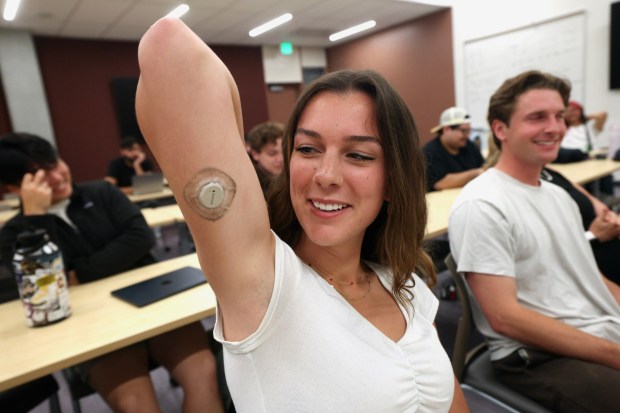
Adam Van Voorhees once consumed orange chicken multiple times a week, until a significant change urged him otherwise. At 22, he didn’t consider his dietary choices until his continuous glucose monitor (CGM) alerted him to a blood sugar spike into prediabetic levels after a meal at Panda Express. Now, he prepares his lunches.
Van Voorhees is not diabetic but wears a CGM, a device generally for those with Type 1 diabetes, as part of a class at UC San Diego. Once a prescription-only tool, these monitors are now available over the counter, thanks to efforts by Mary Boyle, a cognitive science professor. Boyle believed this technology could transform how people understand their bodies. With San Diego’s Dexcom marketing these monitors to health-focused individuals, Boyle’s students are examining how CGMs promote healthier habits.
In Boyle’s Metabolic Health Analytics class, students use CGMs as a lens to comprehend their body’s reactions to choices and surroundings. For instance, blood sugar rises with candy or certain meals but levels out after a brief walk.
This real-time feedback aims to encourage healthier decision-making. Devices like these have proven essential for diabetics, influencing survival-critical behavior changes. Now, Boyle’s class is exploring whether this concept applies to non-diabetics. The pilot data gathered might support a future clinical study.
In a recent class, the process of using a CGM was demonstrated. After attaching the device to her upper arm, one student’s phone synced, beginning a 14-day blood sugar monitoring period. Although these monitors typically cost, Boyle secured funding to provide them to students free of charge.
During class discussions, students shared experiences. Many noted blood sugar drops in the afternoon, detecting hunger before feeling it. This aligns with the idea that what some perceive as mood fluctuations, like being ‘hangry,’ is a physiological reaction.
Katie Lam, a student, monitored how stress affected her glucose levels. Rising early after a restless night, she faced exam and interview anxieties, visibly reflected in her CGM readings. Lam learned that relaxation methods, such as meditation, helped normalize her glucose levels.
Boyle explained how hormones and metabolism intertwine. Morning blood sugar naturally increases as cortisol levels rise, stimulating glucose production. This hormonal impact is another area Boyle studies. She’s even extended CGM usage to her rowing team, observing similar insights among women in different life stages.
Some students, like Jaidy Leyva, tested the impact of different treats. After consuming three chocolate cakes from various sources, Applebee’s cake notably raised her glucose, contrasting with the others.
Boyle’s experiment, now in its second year, has inspired some students to maintain healthier habits long-term. Witnessing their body’s response to foods, like smoothies or late-night snacks, has made some rethink these choices.
However, not all feedback is positive. Student Rithika Muttukuru commented on the stresses of constant monitoring, especially with nighttime alarms. Dr. Robert Thomas, an academic endocrinologist at UC San Diego, acknowledged this ‘device burden,’ advising selective monitoring rather than constant use.
Despite the wealth of external advice from various sources, seeing direct effects on their body influenced students like Leyva the most. Real-time feedback fosters a personal relationship with lifestyle variables, providing more than mere recommendations.
 Challenges in Managing Advanced AI Models
  The Risky Foundations of AI’s Economic Impact
  Early Detection of Atherosclerosis and Heart Disease Prevention
  Church Attendance Linked to Increased Sexual Satisfaction for Married Couples
  Dining with Loved Ones May Benefit Blood Sugar Levels
  Urgent Need for Action in East Africa’s Food Crisis