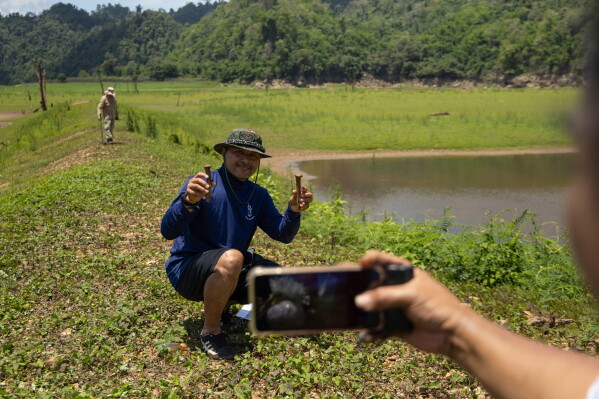
Kanchanaburi, Thailand — A depot on the notorious World War II ‘Death Railway’ has emerged from beneath a reservoir, offering historians a rare chance to study the remnants of Nithe Station. This site has remained submerged for decades beneath a reservoir at Vajiralongkorn Dam, recently drained for maintenance.
Thousands of Allied prisoners of war (POWs) and Asian laborers died constructing the railway, a supply route for occupying Japanese forces across Southeast Asia.
The Electricity Generating Authority of Thailand drained the reservoir for maintenance, revealing the historical site. Researchers have arrived in Kanchanaburi province to study the site for artifacts and validate historical details before the reservoir refills due to the upcoming rainy season.
Historians are seizing this uncommon opportunity to further study the site.
Nithe was a significant station along the 415-kilometer railway linking Thailand, known then as Siam, with Myanmar, then Burma. Approximately 60,000 Allied POWs, including men from Australia, the UK, the US, and Indonesia (Dutch East Indies), as well as hundreds of thousands of Asian laborers, worked on the railway. More than 12,500 POWs and 75,000 laborers died during its construction.
This railway inspired the nickname ‘The Death Railway.’ Featured in films like ‘The Bridge on the River Kwai’ and ‘The Railway Man,’ it also inspired the award-winning novel ‘The Narrow Road to the Deep North,’ with a 2025 miniseries starring Jacob Elordi.
Unique Opportunity for Researchers
Researchers have ventured into the emptied reservoir to explore Nithe Station. Martyn Fryer, an Australian researcher whose grandfather died as a POW here, traveled from Perth to witness the site. He trudged through muddy terrain in sweltering conditions to understand the experience of the workers.
Fryer authored a book on his grandfather’s regiment and found artifacts such as iron dog spikes and bridge staples with a metal detector. He has visited Nithe Station before, but high water levels hindered a full appreciation of the railway’s infrastructure and layout.
Fryer leveraged wartime aerial photographs from the National Archives in London and hand-drawn maps from collaborator Andrew Snow to locate POW camps in the area. Snow, a researcher with the Thailand–Burma Railway Centre, shared how water levels dropping offer greater visibility for study.
Hundreds of Thai visitors have flocked to the area for the ‘rare incident.’ Kitti Laokham, a resident, shared images online, amassing millions of views. Channarong Noimala, inspired by the posts, traveled from Bangkok to witness the station.
Preserving War History
Near Nithe is Hellfire Pass, where hundreds of POWs died. The Australian-funded Hellfire Pass Interpretive Centre commemorated a record 169,000 visitors last year during WWII’s 80th anniversary. Mick Clarke, an Australian Army veteran at the center, stressed the importance of preserving these sites, highlighting their significance for future generations.
Australia’s Department of Veterans’ Affairs cites that 22,000 Australians became POWs during the war, with 13,000 working on the railway and 2,800 dying during its construction. Hellfire Pass holds personal significance for many Australians, linking families to a pivotal wartime history.
These historical sites play a crucial role in keeping these personal stories alive.
 The Threat of Melting Glaciers: A Call to Action
  Police Discover Ancient Roman Artifacts Off Sardinian Coast
  Urgent Need for Action in East Africa’s Food Crisis
  Suspected Plague Death in Siberia Sparks Health Measures
  G7 Nations Agree to Release 100 Million Barrels of Oil Amid Fuel Price Surge
  Co-Pilot Attempts Hijack on Flight to Tel Aviv