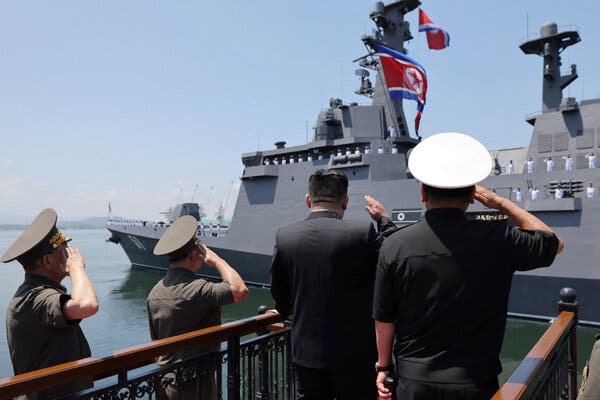
North Korea has officially commissioned its first naval destroyer, named Choe Hyon, which is reportedly armed with nuclear-capable missiles. This development marks a significant step in North Korea’s efforts under the leadership of Kim Jong-un to extend naval power beyond its coastal waters.
The Choe Hyon, weighing 5,000 tons, was unveiled at a ceremony held on Tuesday at Nampo port, southwest of Pyongyang, as reported by state media. This warship is the largest ever built by the country and is a symbol of Kim’s ambition to expand and nuclearize his navy. Since its initial test run in April last year, the vessel has been central to North Korea’s naval strategy.
During the ceremony, Kim Jong-un announced that the navy was entering “full-fledged service” and emphasized that the nuclear weapons program for the navy is proceeding as planned. North Korea’s navy has historically been overshadowed by the fleets of South Korea and the United States, mostly restricted to coastal patrolling due to aging Soviet-era vessels.
The naval expansion aligns with Kim’s recent decision to supply arms and soldiers to Russia, aiding its conflict in Ukraine. Russia is believed to be reciprocating with oil, food, and technology, assisting North Korea in modernizing its military capabilities. Analysts in South Korea suggest that recent missile tests from the Choe Hyon show signs of Russian technological influence, with some weapons like the supersonic cruise missile potentially incorporating Russian advancements.
Traditionally, North Korea’s nuclear capability focused on ballistic missiles, as the country lacked nuclear-capable aircraft or submarines. Recently, however, Kim has prioritized the nuclearization of the navy. Efforts include testing submarine-launched ballistic missiles, revealing the hull of a nuclear-powered submarine, and developing unmanned underwater vehicles reportedly capable of carrying nuclear warheads.
 British Police Arrest Man Suspected of Terror Plot
  Activists Push for Nationwide Ban on Child Marriage in the U.S.
  Investigation into Alleged Incident at Cornell University
  Rising Drone Threats Highlight Vulnerabilities in Moldova’s Airspace Defense
  Bolivia Faces Security Test Amid Unrest
  Incident on FlyDubai Flight Raises Security Concerns