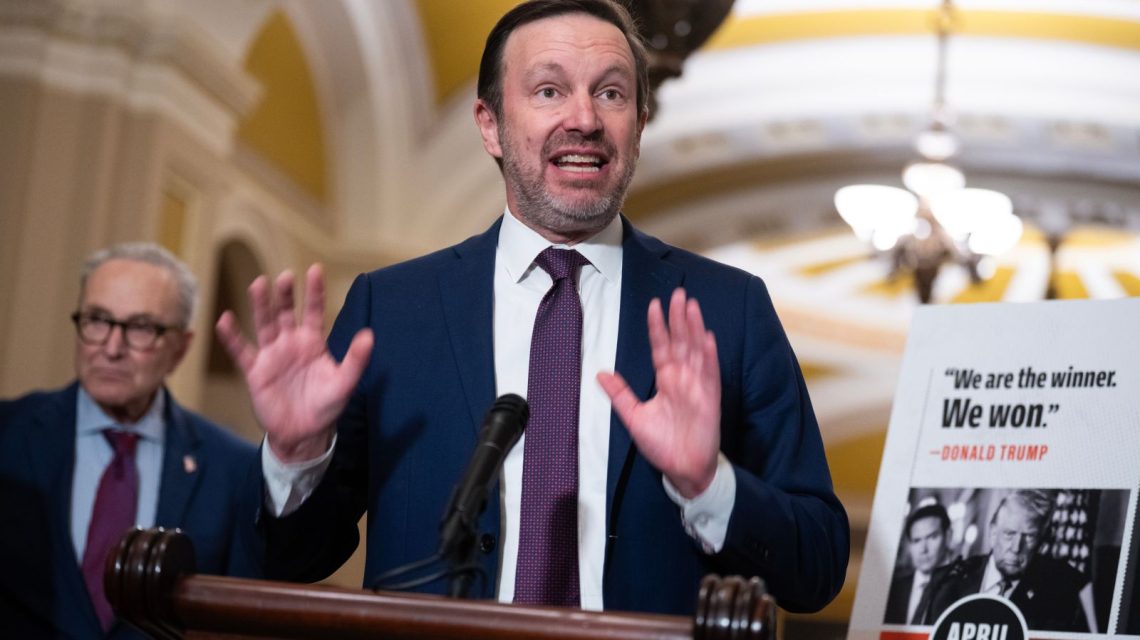
Senator Chris Murphy emphasized the significance of increasing the federal minimum wage as a strategic measure to reconstruct the Democratic coalition. During a segment on NBC News’ Meet the Press, he underscored the potential of his proposal to raise the wage to $25 an hour. This plan aims to appeal to working-class voters who previously supported Donald Trump.
Murphy argued that this wage increase could serve as a ‘unifying issue’ that resonates with individuals across political parties. He expressed concerns that the current capitalist system has failed, as evidenced by 40% of full-time American workers lacking sufficient savings for emergency expenses. The federal minimum wage has been stagnant at $7.25 since 2009, highlighting a significant issue within the Democratic Party regarding balancing progressive economic policies with electoral appeal, especially before the midterms.
A Proposal for a ‘Living Wage’
The “Living Wage for All Act,” introduced by Murphy, aims to progressively establish a $25-an-hour baseline. Large employers are expected to meet this benchmark by 2032, while smaller businesses have until 2039. The plan mandates an initial increase from $7.25 to $12 hourly upon enactment. Currently, no state mandates a $25 minimum, with Washington state leading at $17 per hour.
Murphy contends that gradually raising the minimum wage will generate more jobs than it will eliminate, countering concerns about potential job cuts. He noted that surveys indicate Democrats prefer a $27 minimum wage, while Republicans and independents favor $26. These figures reflect the ‘minimum wage necessary to cover expenses’ in the current economy and may attract Trump voters.
Despite support, critics warn about potential risks, including reduced hiring and increased consumer prices. Small businesses might face layoffs or closures due to narrow profit margins. Some studies suggest limited employment impact, provided the wage increase is gradual. The bill assures future adjustments by indexing the wage to two-thirds of the national median wage, ensuring it keeps pace with economic growth.
Targeting Disaffected Trump Voters
Murphy’s proposal emerges as Democrats explore strategies to retrieve working-class voters who shifted towards the Republicans under Trump. He noted that these voters are driven by economic dissatisfaction and misperceptions about Trump’s approach to the economy.
Murphy emphasized the need for Democrats to address vital economic issues like minimum wage hikes and revitalizing labor unions. He advocated for welcoming individuals who aren’t fully aligned with the Democratic platform on social matters, like gun control and climate change.
While Murphy dismissed socialism as a path for Democrats, he proposed adopting ‘common good capitalism’ as a pragmatic alternative. This reflects a focus on tackling corporate power consolidation without alienating potential voters.
The Cost-of-Living Squeeze
The legislative proposal arises during an ongoing cost-of-living crisis in America. Essential expenses, such as housing and food, often surpass wage growth. Data indicates home prices soared by 81% since 2017, and rents jumped 54%. Habitat for Humanity reports that the median home price reached $412,500 in 2024, requiring an income of roughly $126,700 annually.
Food prices rose 3.2% in 2025, per the USDA, exacerbating strain on budgets. Despite inflation slowing to 4.2%, housing and food remain disproportionately costly for lower- and middle-income households.
Senator Murphy insists that intervention is vital, arguing that full-time work should ensure financial sufficiency. However, the bill faces considerable political challenges, with Republicans expressing concerns about negative impacts on economic growth and inflation.
 Maryland First State to Restrict Electronic Pricing in Grocery Stores
  Activists Push for Nationwide Ban on Child Marriage in the U.S.
  Democratic Hopes and Historical Warnings in 2026 Senate Race
  Republicans Face Challenges Amidst Cost of Living Concerns
  A Different Kind of Fall for Congress This Year
  Cornel West and Sean Hannity Discuss Differences on Podcast