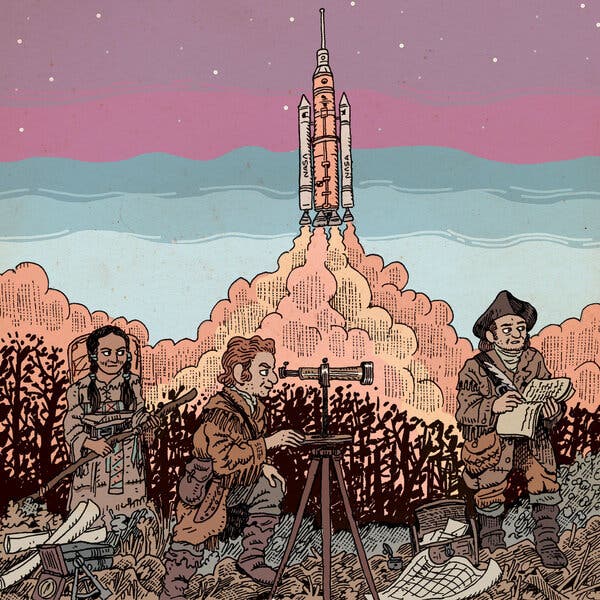
In recent developments, the Trump administration halted or canceled 7,840 research grants, according to a report by Nature. These include those supported by the National Science Foundation and the National Institutes of Health. This trend of budget cuts could impact America’s future and its historical roots, as significant public investments have played a crucial role in shaping the nation.
The Early Days of Federal Research Funding
Meriwether Lewis and William Clark received what is arguably one of the first major federal research grants. In 1804, tasked with the mission of finding a trade route via the Missouri River, across the Rocky Mountains to the Pacific Ocean, they required financial backing. President Thomas Jefferson initially requested $2,500 from Congress, though he was aware that the actual costs would be much higher. Upon completion of the expedition in 1806, the War Department calculated expenses at $38,722.25. Including all related costs, the total expenditure exceeded $100,000. Considering the annual federal budget was about $10 million at the time, this expedition represented a significant investment, comparable to today’s spending on NASA.
Science and Exploration
Much of the investment in Lewis and Clark’s expedition was channeled into scientific research. Jefferson tasked Lewis with collecting extensive data across various fields including botany, zoology, geology, and climatology. Before setting out, Lewis engaged with prominent American scientists, as Jefferson believed transforming a soldier into a scientist was more feasible than the reverse.
During the expedition, all members contributed to the research efforts. Clark was responsible for mapping and making astronomical observations that proved remarkably accurate. Sacajawea, a Shoshone woman, collected botanical specimens, while York, an enslaved Black man, gathered invertebrate samples. However, most research duties were performed by Lewis, whose keen observation skills were instrumental. His findings, which included flora, fauna, and minerals, were meticulous and thorough, despite occasionally proving hazardous.
Impact on America
The scientific endeavors of Lewis and Clark’s expedition also had strategic implications related to territorial expansion. Jefferson envisaged that the expedition’s data would enhance America’s international standing and support future territorial claims. Although the captains were conscious of expansion, the consequences for Native populations were largely overlooked.
The expedition’s findings yielded tangible benefits, particularly in fostering the fur trade. A trader established a post near the Pacific Coast based on Lewis’s recommendations. The expedition exemplified the erratic nature of research, contributing indirectly to events such as the identification of the Oregon Trail. This discovery was influenced by individuals inspired by the expedition’s legacy.
 Climate-Resistant Rock Glaciers: Hidden Water Resources
  California Voters to Decide on $7.5 Billion State Research Fund
  Ancient Pottery Unearthed During Roadworks in Tbilisi
  U.S. Space Academy Announcement
  The Need for New Strategies in Oregon’s Wildfire Management
  Plastic Pollution in the Great Lakes: A Growing Concern