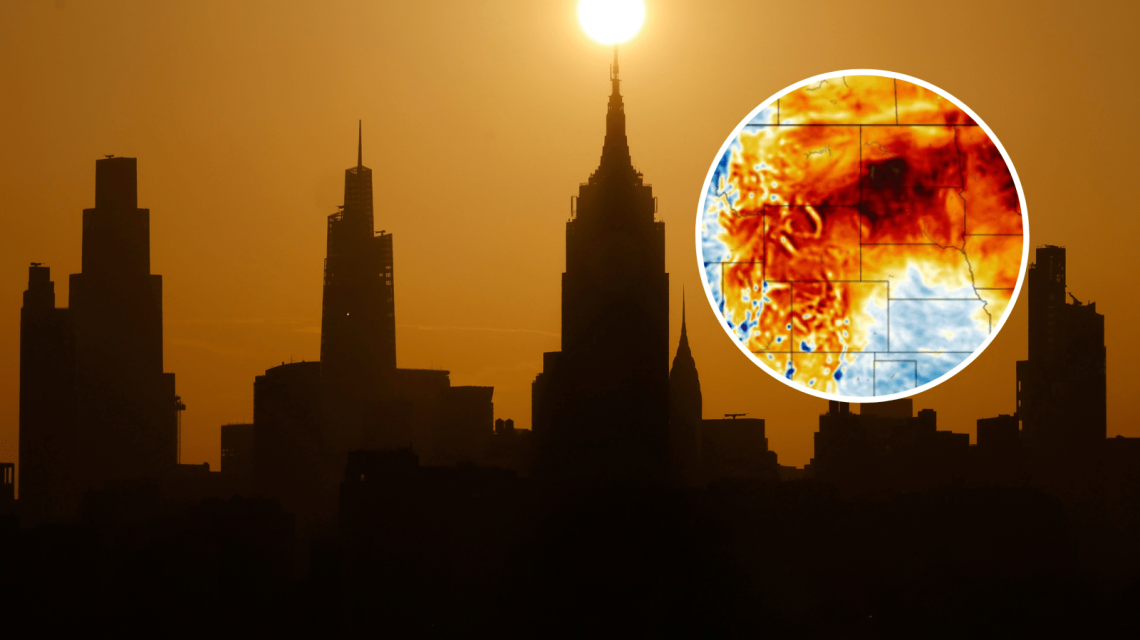
Expanding Heat Dome Impacts Millions
A sprawling heat dome is stretching from the Plains to the Northeast, impacting millions of Americans with hazardous heat and humidity. This phenomenon has led to advisories urging people to remain indoors and take precautions against the life-threatening conditions.
The heat dome intensifies across large portions of the U.S. this week, with temperatures reaching triple digits and humid conditions affecting areas from the Rockies and Plains to the East Coast. Meteorologists warn that extreme heat combined with warm nights could increase the risk of heat-related illnesses, stress power systems, and exacerbate drought conditions in affected areas.
Serious Health Risks Loom
This round of severe summer heat follows a recent showing during the Fourth of July celebrations. Though not expected to be as intense or prolonged, meteorologists confirm significant health risks remain for millions. A heat dome occurs when high pressure traps warm air near the surface, suppressing rainfall in parts of the central U.S. which may worsen drought conditions and challenge agricultural operations.
Expected Temperature and Warning Details
- Heat index values of 105 to 115 degrees are anticipated across sections of the Plains and Great Lakes by AccuWeather.
- Tuesday sees peak heat in the central U.S., before shifting eastward.
- On Wednesday, New York City could reach the upper 90s, exceeding the average by about 10 to 15 degrees.
- Philadelphia forecasts 100 degrees with perceived temperatures nearing 105 degrees.
- Extreme heat advisories are active in multiple states, including California, Arizona, New Jersey, and Pennsylvania.
- Desert regions in the Southwest may experience highs of 113 to 116 degrees.
Humidity and ‘Steam-Cooker’ Conditions
Humidity is projected to intensify the heat event, making temperatures feel significantly hotter than actual thermometer readings. AccuWeather’s Noah Bodner describes East Coast conditions as a “steam-cooker” environment, reflecting the high dew point levels and increased humidity.
Temperatures may feel well over 100 degrees in areas such as Minnesota, Iowa, and Missouri. Elevated air moisture complicates the body’s ability to cool itself through sweating, raising the likelihood of heat exhaustion and stroke.
Unusually warm nights, with temperatures staying in the 70s after sunset, exacerbate cumulative heat stress and pose greater risks to vulnerable populations.
Extensive Heat Warnings in Place
Extreme heat warnings span vast sections of the U.S., including Southern California where Los Angeles, Orange, Riverside, and San Diego counties face forecasts in the upper 90s and low 100s. Desert locations could see temperatures of 113 to 115 degrees.
Warnings cover regions in Arizona and southeastern California, forecasting temperatures between 106 and 116 degrees. Meanwhile, New Jersey, Pennsylvania, and Delaware might witness heat index values reaching 107 degrees on Wednesday.
National Weather Service offices stress the escalation in heat-related illnesses during extreme events, particularly when temperatures persist overnight. Alerts are also active across Minnesota, North Dakota, Montana, Wyoming, Michigan, and Utah where forecasters predict warm nights providing minimal respite.
Precautionary Measures Recommended
Meteorologists advise limiting outdoor activities during the peak heat of the day. AccuWeather’s Brandon Buckingham recommends seeking shaded areas, wearing light-colored clothing, and ensuring hydration.
Residents should consume ample fluids, stay in air-conditioned zones, and refrain from strenuous activities during the hottest hours. Authorities emphasize that children and pets must not be left in unattended vehicles due to rapid temperature rises.
Checking on older family members, neighbors, and susceptible community members, especially without reliable air conditioning, is encouraged.
Potential Thunderstorms Pose a Subsequent Threat
Although the main concern remains extreme heat, there’s potential for severe thunderstorms as the heat dome starts weakening across the Northeast. AccuWeather forecasts thunderstorms originating from the Great Lakes reaching New England, posing risks of damaging winds, hail, intense rainfall, and isolated tornadoes.
Tuesday into Tuesday night, Northern New England may face strong storms, potentially leading to downed trees and power lines, AccuWeather’s Adam Douty warns. Power outages could complicate matters as nights remain warm, endangering those dependent on AC for heat relief.
Forecasters maintain that immediate attention should focus on the heat threat. With conditions likely to remain across much of the country through midweek, staying cool, hydrated, and responsive to warnings is advised.
 Atlantic Ends September Without a Hurricane for First Time Since 1994
  Bobcat Sightings and Conservation Efforts in Illinois
  2026 El Niño: A Historical Comparison and Future Projections
  U.S. Records Warmest September in History
  Swiss Glaciers Show Effects of Ice Loss Amid Global Warming
  Climate-Resistant Rock Glaciers: Hidden Water Resources