On August 5, 2026, Taiwan commenced significant military exercises aimed at assessing commanders’ ability to respond swiftly to unexpected enemy maneuvers. This marks the first instance of temporarily limiting internet access, according to senior Taiwanese officials. The annual Han Kuang exercise, spanning ten days, kicked off when an underground command center in Taipei issued directives early in the morning. These instructions led to immediate combat readiness actions, including dispersal of fighter jets and emergency naval operations, as stated by two senior officials familiar with the exercise.
For the first time, Taiwan is integrating a backbrief approach, an element of U.S. military procedure where junior officers reiterate mission details to ensure alignment with commanders. This is intended to enhance coordination, explained the officials, who spoke anonymously due to the sensitivity involved. One official remarked that this step is crucial to “ensure commanders and subordinates are in sync on operational intent.”
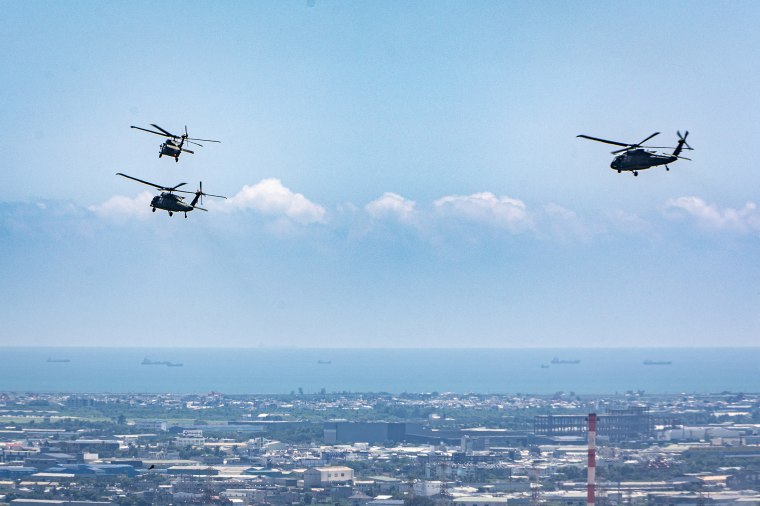
The exercise particularly emphasizes a potential wartime scenario where China might attempt to disable command centers, ports, logistics, and defense industry sites, especially given China’s claim over Taiwan and history of not renouncing force to bring Taiwan under its control. In Kaohsiung, Taiwanese Army UH-60M Black Hawk helicopters executed coordinated air-to-ground drills on the first day of the exercise. China’s defense ministry has not commented on the drills.
Conducted annually since 1984, this year’s drills include a deliberate reduction in mobile internet speeds to evaluate civilian communication with limited bandwidth. The military plans to simulate the relocation of a major arsenal, engage civilian factories, and conduct escort drills off Taiwan’s Pacific coast, amid rising concerns of Beijing’s potential attempts to sever Taiwan’s supply lines.
According to a third senior defense official, these exercises are part of a broader strategy to create realistic conditions, moving away from previous criticisms of overly staged drills. The exercises involve resilience drills that test how local officials would sustain government operations amid various crises like earthquakes or invasions.
The official noted the importance of adapting to unexpected scenarios, stating, “If the situation does not match the original enemy scenario, what should he do? How should he reassess, readjust, and quickly issue orders?” By August 14, more than 20,000 reservists will have participated in these drills.
On Wednesday, in Taipei, reservists practiced using mortars and rifles on a high school sports field. Additionally, the military is introducing an “embedded reporter” mechanism to evaluate wartime news dissemination and combat enemy disinformation, according to officials.
The defense official highlighted that these exercises underscore the need for the entire population, specifically citizens of the Republic of China, to brace for war.
 The Threat of Melting Glaciers: A Call to Action
  Police Discover Ancient Roman Artifacts Off Sardinian Coast
  Urgent Need for Action in East Africa’s Food Crisis
  Suspected Plague Death in Siberia Sparks Health Measures
  G7 Nations Agree to Release 100 Million Barrels of Oil Amid Fuel Price Surge
  Co-Pilot Attempts Hijack on Flight to Tel Aviv