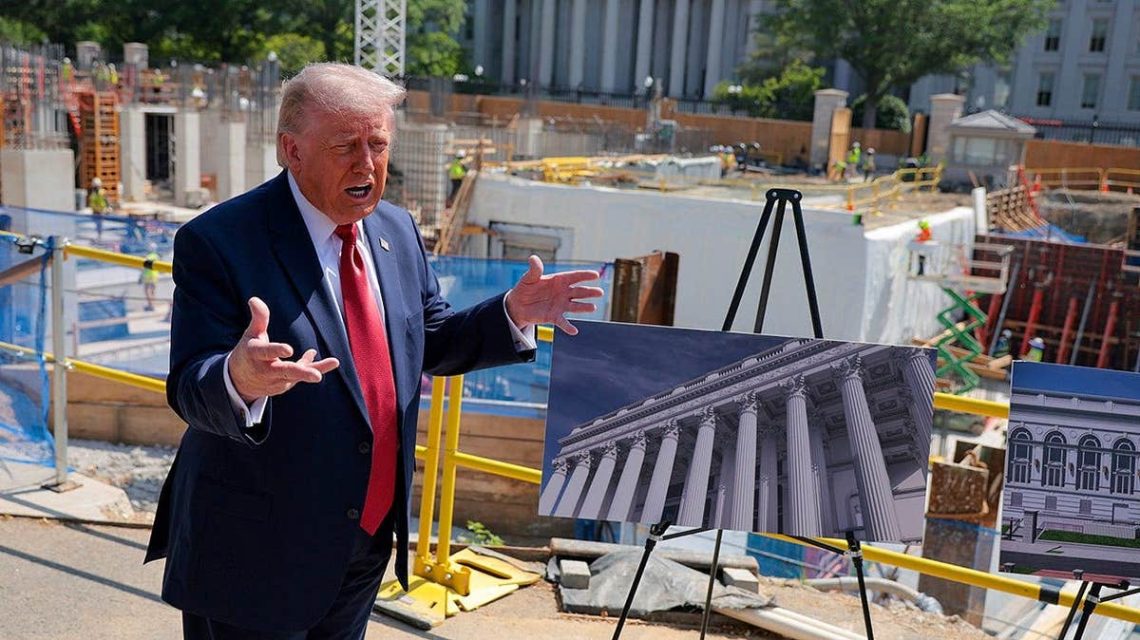
President Donald Trump is gearing up for a potential Supreme Court battle over his proposed White House ballroom. Legal experts suggest that the Supreme Court might resolve the case without delving into the core constitutional issues.
Trump announced his intention to appeal to the Supreme Court following a ruling from the D.C. Circuit. This ruling upheld a lower court’s decision preventing the above-ground construction of the ballroom, stating that it lacks Congressional approval. The ruling came in a 2-1 decision, with Judge Neomi Rao’s dissent providing Trump a basis for appeal. Appointed by Trump, Rao argued the plaintiffs, the National Trust for Historic Preservation, lacked legal standing.
The National Trust’s case revolves around a member, Alison Hoagland, who frequents the White House area. Hoagland claims the ballroom would detract from her enjoyment of the President’s Park due to its size.
“The district court elevated the aesthetic displeasure of a single passerby over the government’s security concerns,” Rao wrote.
A former Justice Department attorney, Abhishek Kambli, agrees. He suggests the National Trust struggles to demonstrate a concrete injury needed to challenge the project effectively.
Hans von Spakovsky, from Advancing American Freedom, also believes Trump could succeed on appeal. He points out that Supreme Court precedents require demonstrable injury for a claim to proceed. He questions whether Hoagland’s aesthetic concerns meet this standard.
If the Supreme Court accepts the case, it might dismiss it on the grounds of lacking standing without addressing the broader issue of presidential authority over federal property construction. Spakovsky notes that Congress could potentially establish standing, but partisan divides make this unlikely.
The dispute extends to interpretations of federal law. The National Trust contends Congressional approval is mandatory for construction in Washington, D.C., which the administration counters, citing existing legal provisions granting the president authority over federal property alterations.
“It’s the same property, subject to improvements or alterations,” Kambli noted, drawing from real-property terminology.
This ongoing legal contest over the ballroom underscores broader debates about presidential authority and federal property governance.
 Sen. Cotton Opposes Permanent Daylight Saving Time
  Steve Hilton’s Latino Outreach and Gubernatorial Ambitions
  The Need for Reform in Presidential Nominations
  Controversy Surrounds Performances at Gillette Stadium
  Celebrity Controversies Over Political Activism and Speech
  Trump Pushes for Permanent Daylight Saving Time, Sharing Senator’s Contact Information