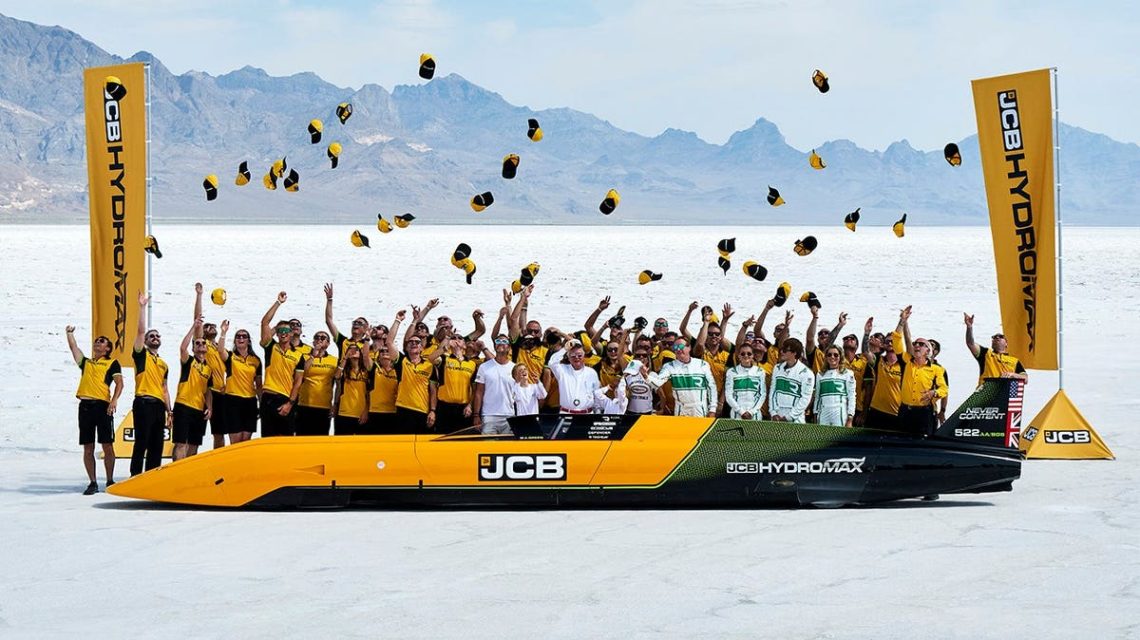
The Bonneville Salt Flats played host to an impressive feat in automotive engineering with the JCB Hydromax. This hydrogen-powered car set a new world land speed record on Tuesday.
Record-Breaking Speed
The JCB Hydromax, equipped with twin engines and measuring 32 feet, completed two record-breaking runs. It recorded an average speed of 400.623 mph during the first run and 412.135 mph in the second run. This achievement established an unprecedented average speed of 406.320 mph, surpassing the previous 185.5 mph record set by the BMW H2R in 2004. Official confirmation from the Fédération Internationale de l’Automobile (FIA) is pending.
Hydrogen Racing: A New Class
The record-breaking event at Bonneville Speed Week marked the debut of a new class for hydrogen racing using internal combustion engines. Wing Commander Andy Green, OBE, who piloted the car, described the engineering success as “extraordinary.” The effort took slightly over a year from conceptualization to execution, a process that normally spans three to five years.
Engineering Challenges
The journey to 400 mph was filled with technical obstacles. Engineers designed and manufactured components within nine months, building the car in five weeks. Testing took three weeks in the UK before heading to Bonneville. Some challenges included operating 6,000 to 7,000 feet above sea level and controlling temperatures between 100 to 105 degrees.
Cooling and Safety Measures
Cooling the high-energy engine in a compact space required innovation. The car carried 400 pounds of ice and water to keep the engines and intake air cool. Hydrogen engines need cool air to function safely; hot air can cause dangerous reactions. Engineers also had to ensure that engine oil was heated to prevent water from damaging the engine components.
“Instead of five or six years, they did it in five or six days,” said Green.
The car’s parachute system, critical for safe deceleration, was tailor-made to stop a 5,500-pound car traveling at 400 mph.
Reflections from the Driver
After achieving the first successful run, Green and his team conducted assessments and changed the tires, necessary due to extreme heat generated at high speeds. They pushed the car further in the second run, achieving a new world record pending confirmation.
Green described the surreal experience of steering at such high speeds, where visual effects make the track appear narrower. At these speeds, reaction time is crucial.
Looking to the Future
Green’s background as a jet fighter pilot provided a strong foundation for driving at supersonic speeds. Since setting the absolute world land-speed record of 763.035 mph in 1997, Green continues to push boundaries.
Today’s achievement highlights the potential of zero-carbon technology. The hydrogen engine demonstrates a future where motorsport can thrive without contributing to carbon emissions. It’s a promising vision for what’s next in automotive advancement.
 Minneapolis Council Member Faces Criticism Over Autonomous Vehicle Concerns
  Senate Democrats Block Data Center Bill Over Efficiency Concerns
  Trump and Lawmakers to Discuss AI Regulation at the White House
  America’s Growing Data Center Infrastructure: A Nationwide Transformation
  Pro-Data Center Party Stirs Controversy Amid Rising Tensions
  Todd Blanche Rejects AI Legislation Calls