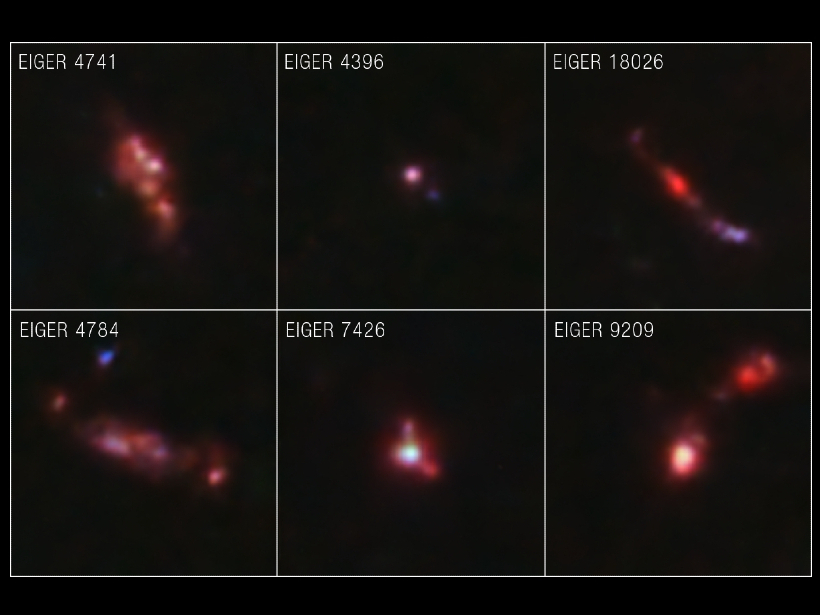
The James Webb Space Telescope (JWST) has sent back impressive images and spectra, offering glimpses into galaxies from 900 million years after the universe’s birth. Credited for this are institutions like NASA, ESA, and CSA, and individuals such as Simon Lilly and Daichi Kashino among others.
Unveiling the Far Reaches of the Universe
JWST stands as the most powerful telescope in space, paving a new way for astrophysics. Astronomers now peer farther into the past, revealing galaxies forming just 200 to 500 million years post-Big Bang. These galaxies appear larger and brighter than expected, igniting debates and excitement in the scientific community.
“In astronomy, we look at our history,” states Jorge Moreno, associate professor at Pomona College, emphasizing the telescope’s role in exploring the deep past.
How the Telescope Sees the Unseen
JWST detects the faint light from distant galaxies, transformed over time into the infrared spectrum. This light elongation process, known as cosmological redshift, helps the telescope capture early universe glimpses. Comparatively, Proxima Centauri’s light reaches Earth in over four years, highlighting the vast distances involved.
Galactic Surprises in Early Universe
The brightness of these galaxies suggests unexpected massiveness, linked to the light emitted by their stars. Moreno likens spotting these galaxies to finding a teenager in a kindergarten; surprising developments defy existing models. Potential factors like active black holes and hot dust may skew mass estimations.
Structure in Young Galaxies
Previously, early galaxies were thought to lack definite structures, resembling ‘blobs’ instead of defined forms. Yet, JWST reveals highly organized structures, sometimes akin to local universe galaxies, provoking further explorations.
Questioning the Universe’s Age
The brightness and structure of these galaxies challenge longstanding beliefs about the universe’s timeline. A hypothesis proposed doubling the universe’s age from 13.8 billion to 26.7 billion years. This combines the accepted universe expansion model and the debunked tired light model. Moreno remains skeptical, advocating for evidence over complex suppositions.
Continued Exploration and Reflection
With ongoing data from JWST, possibilities for new interpretations emerge. While Moreno values discovery, he stresses the importance of slowing down for thoughtful analysis, learning from galaxies’ cycles of brightness changes.
 The Threat of Melting Glaciers: A Call to Action
  Climate-Resistant Rock Glaciers: Hidden Water Resources
  California Voters to Decide on $7.5 Billion State Research Fund
  Ancient Pottery Unearthed During Roadworks in Tbilisi
  U.S. Space Academy Announcement
  The Need for New Strategies in Oregon’s Wildfire Management