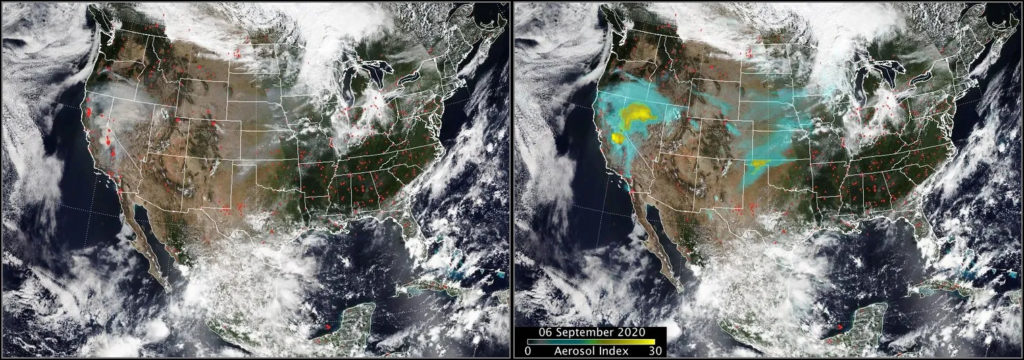
As wildfires become larger and more intense globally, researchers are conducting airborne missions to study the extreme storm clouds that often form over severe fires. Known as pyrocumulonimbus or ‘firestorm’ clouds, these formations can produce as much smoke as volcanic eruptions, affecting weather patterns significantly. Despite their impact, much remains unknown about these clouds, making them unpredictable and potentially hazardous.
This summer, NASA, the U.S. Naval Research Laboratory (NRL), and the National Center for Atmospheric Research (NCAR) collaborated on a mission to closely examine these clouds. Using aircraft equipped with various measuring instruments, the team collected real-time data from active wildfires. This groundbreaking mission, called INSPYRE (Injected Smoke and Pyrocumulonimbus Experiment), aims to uncover the characteristics of these clouds and their atmospheric effects.
“Being able to sample inside the plumes and clouds and above is unprecedented,” said John Yorks, a scientist at NASA’s Goddard Space Flight Center.
The INSPYRE mission has been likened to a well-organized storm chase, focusing specifically on storms triggered by wildfires. The team’s recent deployment marked a significant success, providing researchers with unique insights into the clouds’ structure. The experience of flying into these clouds was described as surreal, with the environment illuminated by a dark, orange hue due to the heavy smoke.
Formation of Firestorm Clouds
Under conditions of heat, dryness, and wind, wildfires can generate dense smoke plumes that rapidly transport water vapor and smoke particles high into the atmosphere. As the water vapor cools, pyrocumulonimbus clouds form and expand at the plume’s summit. These clouds act as colossal chimneys, pushing smoke upward and often generating their weather systems.
“Predicting when they will occur is crucial for emergency planning,” stated Michael Fromm, a meteorologist at NRL. He noted their destructive potential, including dry lightning and strong winds.
Although commonly observed in North America and Australia, similar events are appearing across Europe amid increasing temperatures. France witnessed its first such cloud in July, marking a significant change in the region’s climate patterns.
Challenges in Understanding Firestorm Clouds
The complexity of pyrocumulonimbus clouds has posed research challenges. Understanding their formation, correlation with local meteorology, and their atmospheric impact is essential for accurate forecasting. INSPYRE builds on earlier research, aiming to bridge data gaps by providing detailed on-site observations.
“Direct, in situ data was lacking until now,” explained Ziming Ke, research scientist at the Desert Research Institute. Ke emphasized the need to understand aerosols within the clouds, crucial for predicting lightning and atmospheric changes.
Researchers aim to better model these clouds, anticipating their formation and potential hazards to improve emergency responses. Key areas of study include the role of black carbon and its atmospheric effects, particularly its heat absorption after being elevated by firestorm clouds.
INSPYRE Mission Operations
The mission involved coordinated efforts from over 150 personnel, utilizing aircraft with specialized equipment to track and sample from the clouds. One plane carried remote sensors, while another collected air samples, providing comprehensive data on the clouds’ composition and dynamics.
Ongoing analysis of the collected data promises to refine fire and weather models, aiding in future forecasts of such events. Future deployments will aim to address any identified informational gaps and continue advancing the understanding of these complex natural phenomena.
 Swiss Glaciers Show Effects of Ice Loss Amid Global Warming
  Climate-Resistant Rock Glaciers: Hidden Water Resources
  California Voters to Decide on $7.5 Billion State Research Fund
  Senators Reach Bipartisan Agreement on Permitting Reform
  Experts Warn of Critical Period for the Colorado River
  Future Cities: Ambitious Projects Aiming for Innovation and Sustainability