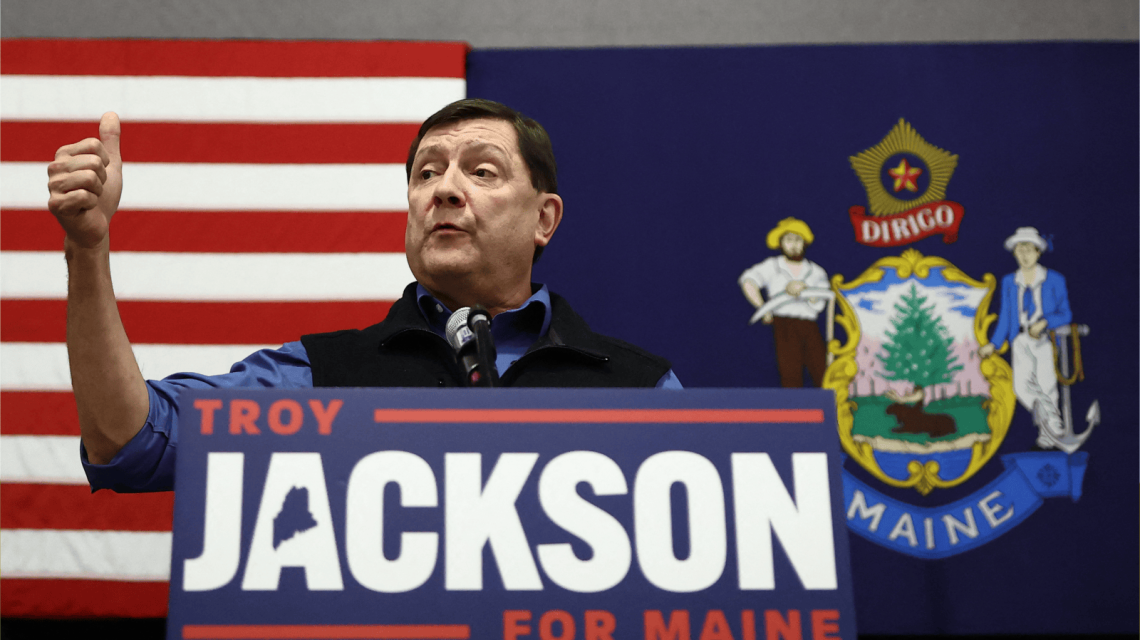
Lana Pelletier, longtime partner of Maine Democratic Senate candidate Troy Jackson, is reportedly his second cousin. This relationship has drawn attention in one of the country’s closely watched Senate races. The claim first surfaced on July 30 in The Maine Wire, which stated that genealogical records indicate Pelletier and Jackson share the same great-grandparents. The National Republican Senatorial Committee (NRSC) later republished parts of the report. However, birth, marriage, or genealogical records supporting the claim have not been publicly provided, preventing Newsweek from independently verifying the family connection.
Newsweek has reached out to Jackson’s campaign and The Maine Wire for comments and requested access to records related to the report.
Who Is Troy Jackson?
Troy Jackson is a fifth-generation logger from Allagash, northern Maine. He is also the former president of the Maine Senate. Jackson’s official campaign identifies him as a “lifelong fighter for workers’ rights” and the Democratic candidate for the U.S. Senate. Jackson entered the 2026 Senate contest as the Democratic nominee after winning the party’s nominating convention on July 25. He is set to challenge Republican Senator Susan Collins in the November 3 general election.
Who Is Lana Pelletier?
Pellettier has been Jackson’s partner for decades, and they have two adult sons, Chace and Camden, according to The Maine Wire. Described as high-school sweethearts, the couple attended Fort Kent High School. Jackson listed Pelletier as an immediate family member in a 2019 financial disclosure with the Maine Ethics Commission. The commission’s form requires lawmakers to report certain income received by a spouse or domestic partner and dependent children.
In a written testimony submitted to the Maine Legislature in April 2023, Pelletier identified herself as a resident of Allagash and a social worker. She mentioned starting smoking at 15 and quitting in her 20s when she became a mother. Pelletier supported a proposed ban on flavored tobacco products in the testimony, discussing “how addiction can tear families apart and ruin lives.” Although referred to as Jackson’s wife in some public documents, The Maine Wire noted no marriage license for the couple could be found.
What Do the Genealogical Records Say?
The Maine Wire claims Jackson and Pelletier share the same great-grandparents, Thomas Pelletier and Edith Thibodeau Pelletier. The report states their daughter, Albertine Pelletier O’Leary, was Jackson’s grandmother, while their son, Louis A. Pelletier Sr., was Pelletier’s grandfather. This would make Jackson’s mother and Pelletier’s father first cousins, and Jackson and Pelletier second cousins. Although the report referenced “genealogical records” and local sources, it didn’t publish or link to original records supporting each family tree element.
Maine law doesn’t prohibit marriage between second cousins. It does bar marriage between closer relatives like parents, children, siblings, aunts, uncles, nieces, and nephews. First cousins can marry but must provide a physician’s certificate proving genetic counseling.
How Close Is Maine Electoral Race?
The Senate contest remains tight, with the RealClearPolitics average showing Jackson at 48.6 percent and Collins at 47.3 percent, giving Jackson a marginal 1.3-point lead. Control of the U.S. Senate may hinge on a few competitive races, making the campaign closely watched. Jackson’s campaign prioritizes his logging background, support for organized labor, and criticism that Washington favors the wealthy and large corporations over working families.
Newsweek’s team used Martyn, our AI assistant, to produce this story. Contact Newsweek editors Ben Kelly and Tony Phillips for more information.
 Mississippi Senate Race: Democrat Challenges GOP Incumbent
  Hochul Faces Criticism Over Immigration Policy Stance in Debate
  Bear’s Halloween Candy Adventure in Alaska Hospital
  Supreme Court Examines Digital Privacy in Salazar v. Paramount Global
  High School Athletes Protest Gender Policy at Cross-Country Meet
  Trump Announces Weapons-Testing Facility in Montana and Defends Policies